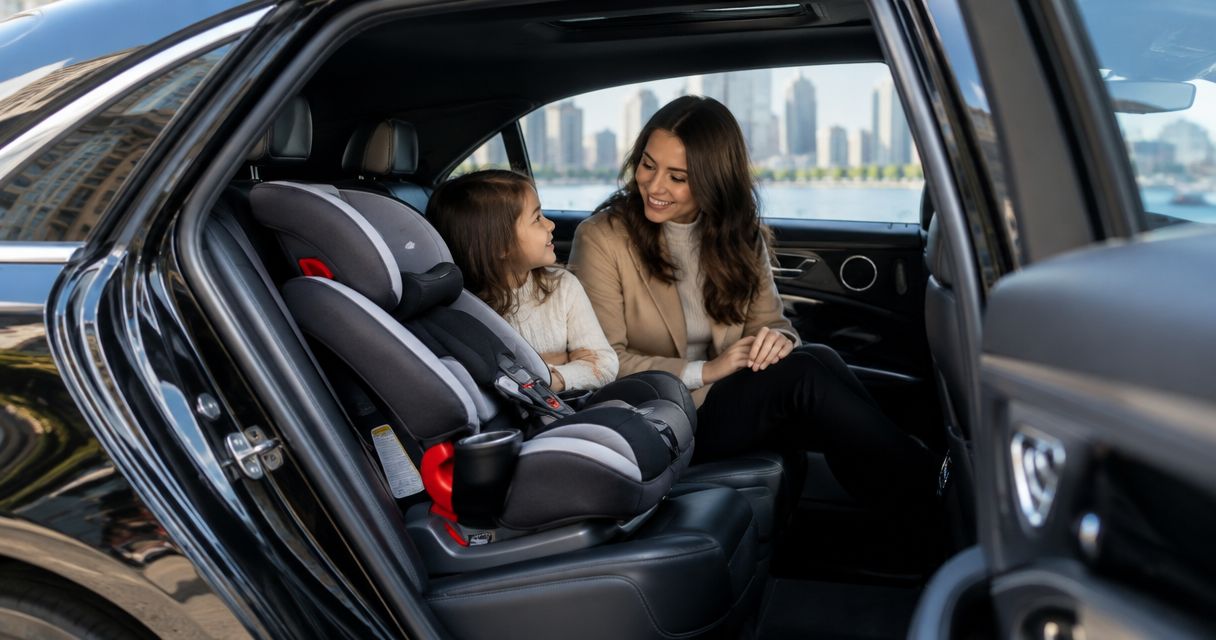
You can bring your own child car seat in a Boston limo when the operator confirms that the assigned vehicle and seating position support its installation. Arrange this before booking, follow both the car-seat and vehicle manuals, and do not treat a limousine reservation as confirmation of a suitable child-restraint position. For a 2026 family trip, confirm the restraint arrangement for every journey, including the return transfer.
- A car seat Boston limo service booking needs vehicle-specific confirmation, not just a request for a larger vehicle.
- Massachusetts generally requires child restraints for passengers under age eight unless they are taller than 57 inches.
- Blacklimoboston provides chauffeur-driven Boston transportation; confirm your child-restraint requirements directly before booking.
- Bring your car-seat instructions and check the installation before the vehicle moves.
Can you bring a car seat for a child in a Boston limo?
Yes, provided the operator accepts your seat and confirms a compatible seating position in the assigned vehicle. Permission to carry a car seat is not the same as confirmation that you can install it correctly.
For a 2026 reservation, use the contact page to explain your requirements before committing to the vehicle. Ask for a written response covering the seat, passenger count, luggage and return journey.
Follow this sequence:
- Describe your child. Give their age, current height and weight, plus the type of restraint they use.
- Identify your seat. Provide the manufacturer and model, its installation instructions, and whether you need a separate base.
- Confirm the vehicle. Ask which vehicle and seating position will accommodate that restraint under both manufacturers’ instructions.
- Assign installation responsibility. Establish who will install the seat and who will check the child’s harness or belt fit.
- Plan the pickup. Allow for installation and adjustment before departure rather than treating boarding as an immediate drive-away.
- Confirm every leg. Repeat the arrangement for the return trip and any separately booked vehicle.
A request recorded as “traveling with a child” is incomplete. The useful confirmation identifies the restraint arrangement and the vehicle requirements that make it workable.
Why this matters
A chauffeur-driven vehicle does not make child-restraint fit automatic. The seat must suit your child, the vehicle must support the installation, and the restraint must be used according to its instructions.
Massachusetts General Laws, Chapter 90, Section 7AA generally requires a child passenger restraint for children under age 8 unless they are taller than 57 inches. The statute requires the restraint to be properly fastened and secured according to the manufacturer’s instructions. Check the current statutory requirements and applicable exceptions for your particular vehicle and journey.
For your 2026 planning, separate the legal threshold from the fit decision. Reaching a birthday does not establish that an adult seat belt fits correctly, and a vehicle’s passenger capacity does not establish that every seating position accepts your restraint.
The National Highway Traffic Safety Administration advises keeping children in the appropriate restraint until they reach its manufacturer’s height or weight limit. Use those instructions alongside the vehicle manual, rather than choosing a seat solely by age.
Rear-facing seats: best for children within rear-facing limits
Keep your child rear-facing until they reach the rear-facing height or weight limit specified by the car-seat manufacturer. NHTSA recommends rear-facing travel for as long as the child fits within those limits.
The benefit is restraint designed for that stage of development. The practical constraint is installation space: you must confirm that the assigned seating position accommodates the seat at its required angle without conflicting with the vehicle instructions.
If you use an infant carrier, check whether its instructions permit installation without a base. Do not assume every carrier supports that method, and do not leave the base behind until you have checked your specific model.
Ask about access as well as fit. You need to position the restraint, secure it correctly and adjust the harness without rushing because other passengers are waiting to board.
Forward-facing seats: best after rear-facing limits are exceeded
Use a forward-facing harnessed seat only when your child meets its requirements and has outgrown the applicable rear-facing limits. Follow the restraint’s instructions for the harness, installation method and top tether.
A forward-facing harness provides a restraint option for the next stage. Its limitation is that the vehicle must support every required part of the installation; a seat belt alone does not answer the tether question.
NHTSA recommends using the top tether with a forward-facing car seat as directed. Ask the operator to confirm the appropriate tether anchor for the assigned seating position, not simply that the vehicle has child-seat anchors somewhere.
Do not attach a tether to a luggage hook or another fitting that merely looks suitable. Only use an anchor identified for that purpose in the vehicle instructions.
Booster seats: best after a harnessed seat is outgrown
A booster seat positions the vehicle’s lap-and-shoulder belt; it does not replace that belt. Use a booster that suits your child and follow its instructions for the assigned seating position.
The advantage is improved belt positioning for a child who has outgrown a harnessed restraint but does not yet fit the adult belt correctly. The limitation is that an unsuitable belt arrangement cannot be corrected just by adding a booster.
NHTSA’s belt-fit guidance calls for the lap belt to lie across the upper thighs, not the stomach, and the shoulder belt to cross the shoulder and chest rather than the neck or face. Your child must also remain properly positioned throughout the journey.
For a 2026 airport transfer, assess fit in the actual vehicle. A belt that fits your child in your family car does not establish the same fit in another seat.
| Restraint option | Best for | Main benefit | Constraint to confirm |
|---|---|---|---|
| Rear-facing seat | Children within the seat’s rear-facing limits | Supports the appropriate rear-facing stage | Installation angle, space and permitted installation method |
| Forward-facing harnessed seat | Children who have outgrown rear-facing limits and meet the seat’s requirements | Provides a harnessed restraint for the next stage | Compatible installation and required tether connection |
| Booster seat | Children who have outgrown a harness but still need belt positioning | Positions the vehicle’s lap-and-shoulder belt | Suitable belt geometry and the child’s ability to remain positioned |
Why child-seat arrangements vary between vehicles
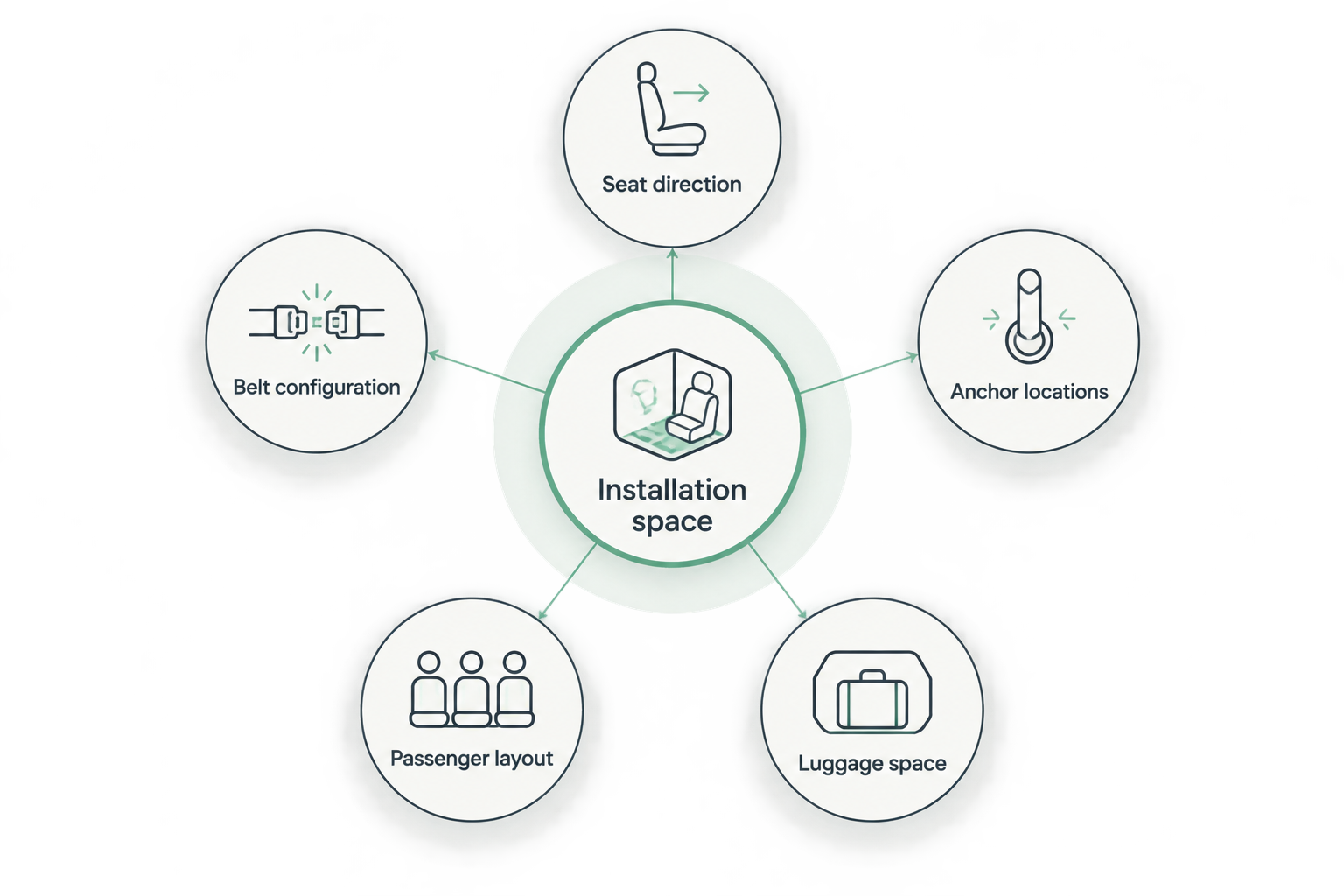
The word “limo” is not an installation specification. Confirm the actual seating arrangement rather than making your decision from a vehicle category or exterior photograph.
These factors determine what you need to check:
- Seat direction: Follow the car-seat manufacturer’s restrictions concerning the direction the vehicle seat faces.
- Belt configuration: Confirm that the seating position has the belt type your restraint requires.
- Anchor locations: Identify the approved lower anchors and tether anchor when your installation uses them.
- Installation space: Check the restraint’s required angle, clearance and permitted contact with surrounding seats.
- Passenger layout: Ensure the installed restraint leaves appropriate seating and belt access for everyone else.
- Luggage space: Account for bags, a stroller and any unused car-seat components without treating passenger seats as unsecured storage.
Choose the seating configuration before choosing the vehicle’s appearance. A larger cabin does not, by itself, establish better child-restraint compatibility.
What should you confirm before a Logan Airport pickup?
For a Logan Airport pickup, settle the restraint arrangement before travel day. Your confirmation should cover the flight, meeting instructions, child-seat installation and the luggage you will bring.
Tell the operator whether you are carrying the restraint through the airport or collecting it with checked baggage. That detail belongs in your pickup planning because the seat must reach the vehicle before you can install it.
Ask where installation can take place without pressure to depart before the seat is ready. Do not assume the pickup arrangement includes installation time or that the chauffeur will install your particular restraint.
For a 2026 return transfer, repeat the request explicitly. If you leave your own seat at your destination, plan how it will be with you when the return vehicle arrives.
Before departure, check the installation using the restraint instructions. NHTSA advises that a correctly installed car seat should not move more than 1 inch side to side or front to back when checked at the belt path. That check does not replace the other installation requirements.
Can the chauffeur install your child’s car seat?
Do not assume the chauffeur will install your child’s car seat. Confirm responsibility before pickup and bring the instructions even if someone has agreed to assist.
A chauffeur’s assistance is not a substitute for model-specific installation knowledge. If you need installation guidance, arrange help from a certified child passenger safety technician before your journey rather than relying on an unfamiliar vehicle at departure time.
You should also know how to adjust your child’s harness and check belt positioning. An installed seat still requires the child to be secured correctly each time they ride.
Avoid adding padding, positioning accessories or other items unless the restraint manufacturer permits them. Use the seat as instructed, not as an improvised solution to a poor vehicle fit.
What should your reservation request include?
Write a specific request that the operator can answer. Include your child’s age, height and weight; restraint manufacturer and model; passenger count; luggage; journey details; and whether you will bring the seat yourself.
Ask for confirmation of a compatible seating position and clarify what happens if the assigned vehicle changes. A substitution needs another compatibility check, not an assumption that the original arrangement transfers automatically.
Blacklimoboston is best suited to travelers seeking chauffeur-driven transportation around Boston and New England. Its stated services include airport transfers, corporate travel, special events and leisure trips; a specific child-seat policy is a separate point to confirm directly.
For a Blacklimoboston car service reservation, describe the restraint requirement before selecting the vehicle. The service category alone does not establish compatibility, installation assistance or a particular restraint arrangement.
Confirm your child-seat requirements
Share your restraint model, passenger count and journey details before selecting a vehicle.
FAQ
Can I bring my own car seat in a Boston limo?
You can bring your own car seat when the operator accepts it and confirms a compatible seating position in the assigned vehicle. Follow both the restraint and vehicle instructions, and establish installation responsibility before pickup.
What are the Massachusetts car-seat rules for children?
Massachusetts General Laws, Chapter 90, Section 7AA generally requires a child passenger restraint for children under age 8 unless they are taller than 57 inches. Check the current statute and applicable exceptions for your vehicle and journey, and follow the restraint manufacturer’s instructions.
Does every limousine have a suitable place for a child seat?
Do not assume every limousine seating position supports your child seat. Confirm seat direction, belt configuration, required anchors and installation space for the actual vehicle.
Can I hold my baby during a short limo ride?
Holding a baby is not a substitute for an appropriate child restraint. Arrange a compatible restraint before departure rather than treating a short journey as a reason to travel without one.
Should I use a seat belt and lower anchors together?
Use only the installation method permitted by both the car-seat and vehicle manufacturers. Do not combine the seat belt and lower anchors unless both sets of instructions explicitly allow it.
Does a booster seat work with a lap-only belt?
A belt-positioning booster requires a lap-and-shoulder belt, not a lap-only belt. Confirm the assigned seating position has the belt arrangement required by the booster instructions.
What should I do if the pickup vehicle changes?
Recheck the restraint’s compatibility before the replacement vehicle departs. Confirm the seating position, installation method and required anchors rather than relying on the earlier vehicle confirmation.
One last thing
A confirmed vehicle category is not a confirmed child-restraint installation. The detail that matters is the actual seating position and whether both manufacturers permit your installation there.
Before your 2026 departure, save the operator’s written confirmation and your car-seat instructions where you can access them without searching through luggage. If the vehicle or seating arrangement differs from the agreement, stop and resolve the restraint fit before the journey begins.