

Boston biotech company car service is chauffeur-driven passenger transportation arranged to connect business travelers with airports, offices, meetings, and events. This 2026 guide explains how to match the itinerary, vehicle, and pickup instructions while keeping passenger travel separate from laboratory logistics.
- For car service for biotech companies Boston, choose by itinerary, passenger count, luggage, and pickup requirements.
- Black Limo Boston serves Boston and New England with chauffeur-driven sedans, SUVs, Sprinter vans, and limousines.
- Use a written trip brief, named travel coordinator, and confirmed pickup instructions for business-critical journeys.
- Treat confidential discussions and laboratory materials as separate requirements, not assumed features of passenger transportation.
Why car service matters for Boston biotech companies
Black Limo Boston car service is best for biotech teams seeking chauffeur-driven passenger transportation across Boston and New England. The practical choice depends on the assignment: an airport arrival, a visiting executive’s meeting schedule, or a group traveling together.
For a biotech visit involving an office, laboratory campus, and dinner venue, the destination name alone is not enough. Your coordinator needs the correct entrance, the person receiving the visitor, and the sequence of stops. A laboratory building’s visitor entrance and its loading area serve different purposes.
Your 2026 transportation brief should make those distinctions explicit. Keep meeting subjects out of driver-facing instructions, give travelers a clear pickup process, and assign someone to approve changes. These controls make the booking easier to manage without assuming that a car service provides security, confidentiality, or specialist handling beyond its documented terms.
Book the movement of people; document every additional requirement separately. That distinction matters when an itinerary includes researchers, investors, visiting partners, or staff carrying work equipment.
How to arrange biotech company transportation
Start with a shared document or spreadsheet. Record the trip before choosing the vehicle or requesting a reservation; otherwise, each participant can end up working from a different version.
Use this sequence: Trip brief, Pickup plan, Vehicle fit, Change control, Passenger handoff, and Trip review. Each stage resolves a different booking decision.
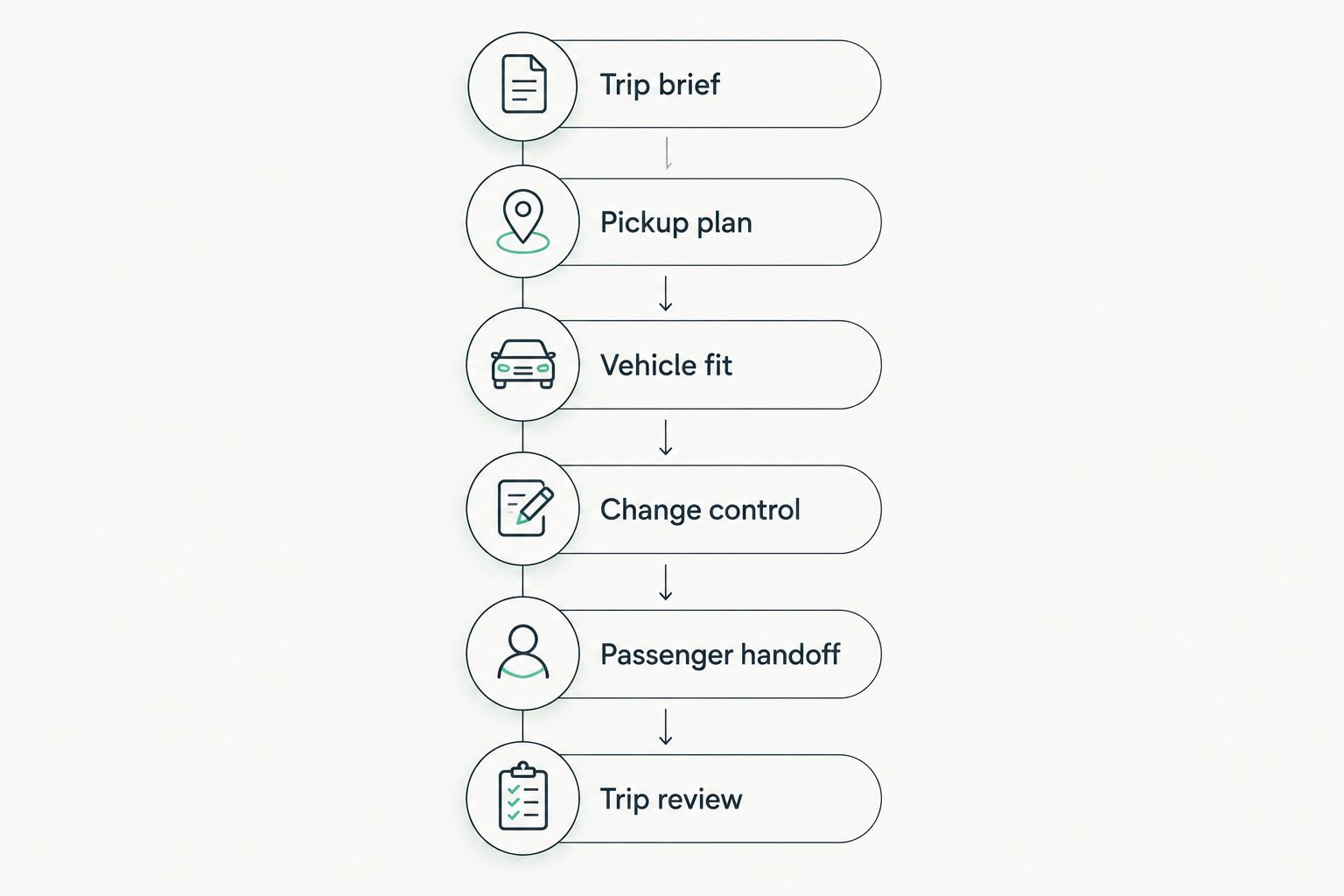
Build your trip brief
Create 1 master itinerary containing the information needed to perform the journey. Email works for a straightforward trip, but a shared document makes revisions easier to follow when several people arrange different legs.
Separate fixed commitments from preferences. A meeting’s required arrival time is a constraint; a preferred departure time is a planning input. Give the transportation provider both, rather than asking for a departure time without explaining the appointment it must support.
For a visitor traveling between several company locations, write each address in full and identify the entrance. Do not assume that the name of a campus identifies the correct drop-off point. Ask the host to confirm visitor access before the itinerary reaches the driver.
Close this stage with a brief that includes:
- Travel date, passenger names, and traveler contact details.
- Full pickup and destination addresses, including entrances.
- Required arrival times and the ordered list of stops.
- Passenger count, luggage, and any mobility requirements.
- A company coordinator authorized to approve revisions.
Define your airport pickup plan
Build the airport leg manually from the flight itinerary and the traveler’s instructions. Record the arrival airport, flight identifier, and destination, then ask the provider to confirm how the passenger and chauffeur will connect.
A flight arrival time is not a passenger-ready pickup time. Baggage collection and the traveler’s route through the terminal are separate parts of the journey. Avoid inserting an unsupported transfer allowance into every booking; ask how the proposed pickup arrangement handles the actual arrival.
For your 2026 airport instructions, distinguish the scheduled flight information from the confirmed meeting point. The Boston Logan Airport car service guide provides a related planning reference; your reservation confirmation should still specify the actual procedure.
Before approving the airport leg:
- Share the flight identifier and arrival date.
- Confirm whether the meeting point is inside or outside the terminal.
- Ask how flight changes and passenger delays are handled.
- Request the contact method if the traveler cannot locate the chauffeur.
- Confirm the onward address and any intermediate stops.
Match the vehicle to the actual load
List passengers and bags before selecting a vehicle category. A sedan, SUV, or van label does not establish the usable capacity of the particular vehicle assigned to your trip.
Black Limo Boston car service includes chauffeur-driven luxury sedans, SUVs, Sprinter vans, and limousines. Presenting the completed brief lets you request a vehicle against actual requirements rather than choosing by appearance alone. Confirm the proposed vehicle’s passenger and luggage fit before accepting the booking.
For colleagues arriving separately, decide whether traveling together serves the itinerary. Keeping a group together simplifies the shared departure, but it also makes that departure dependent on everyone being ready. Separate reservations create more individual arrangements to coordinate.
Use a fit check rather than a category assumption:
- Count every passenger, including accompanying guests.
- Describe suitcases, presentation cases, and other bulky items.
- Ask about entry and seating requirements for each traveler.
- Confirm the exact vehicle arrangement in writing.
- Keep biological materials outside an ordinary passenger booking unless separately documented.
Assign ownership of itinerary changes
Start with 2 named contacts: the traveler and the company coordinator. Add the receiving host where necessary, but keep approval responsibility with a clearly identified person.
A shared message thread is a workable manual method. Mark the current itinerary version and record which changes have been accepted by the provider. Sending a revised calendar invitation does not, by itself, confirm that transportation has changed.
Your 2026 booking procedure should separate a requested change from a confirmed change. Moving a meeting, adding a stop, or changing the passenger group affects the trip brief. Ask the provider to acknowledge the revised arrangement and explain the applicable terms before treating it as settled.
Make change control explicit:
- Identify who can request and approve revisions.
- Keep the current itinerary in one shared location.
- Send changes through the agreed communication channel.
- Obtain written acceptance of revised stops or timing.
- Tell passengers which version is final.
Check the passenger handoff
Send the traveler a short arrival message rather than forwarding an entire internal planning thread. The traveler needs the pickup instructions, destination, and contact route—not the meeting agenda or internal discussion about the visit.
For the receiving host, confirm where the passenger should enter and who will meet them. If building access depends on preregistration, settle that with the host before departure. Transportation instructions cannot replace the destination’s visitor process.
Keep confidential project names, clinical details, and sensitive documents out of routine booking notes. A private vehicle is not a substitute for your company’s information-security rules. Ask about any required confidentiality agreement separately instead of assuming one applies.
Complete the handoff with these checks:
- Send the passenger the confirmed pickup instructions.
- Provide a usable contact route for arrival problems.
- Confirm the destination entrance with the receiving host.
- Share only the personal information needed for the journey.
- Keep sensitive calls and documents subject to company policy.
Review the trip before repeating it
Use 3 review checkpoints: booking accuracy, pickup communication, and itinerary completion. A simple spreadsheet is enough to record whether the confirmed arrangement matched what happened.
Write observable facts rather than general impressions. Record a wrong entrance, an unclear meeting point, or a missing stop so the next booking can address the specific issue. Separate a transportation problem from a meeting that ended later than planned.
For recurring visits, preserve the useful instructions but recheck the details. A familiar destination does not guarantee that the traveler, luggage, access requirements, or schedule remain unchanged. Repeat the process, not an outdated reservation.
Finish each trip review by recording:
- Whether the booking matched the approved itinerary.
- Whether the passenger understood the pickup instructions.
- Any difference between the requested and assigned vehicle arrangement.
- Changes requested during the trip and how they were confirmed.
- Corrections to carry into the next booking brief.
Discuss your biotech travel itinerary
Share your airport, meeting, passenger, and luggage requirements before choosing a vehicle.
Compare transportation options for your team
Choose the option around the journey, not the traveler’s job title. This 2026 comparison separates passenger transportation from the coordination work your company still needs to own.
| Option | Best for | Practical advantage | Key limitation |
|---|---|---|---|
| Black Limo Boston chauffeur service | Planned airport, corporate, and event travel across Boston and New England | Offers sedan, SUV, Sprinter van, and limousine categories | Vehicle fit, pickup procedure, and booking terms require confirmation |
| Separate traveler-arranged rides | Independent travelers with separate destinations | Lets each traveler organize an individual journey | Your coordinator must reconcile separate arrangements and arrival updates |
| Company-coordinated group vehicle | Colleagues sharing an itinerary | Keeps the group on a common departure plan | Changes affect everyone assigned to that departure |
| Public transportation | Travelers whose route, luggage, and access needs suit the journey | Provides an alternative to a dedicated vehicle | Travelers must manage the applicable route, transfers, and station access |
A dedicated chauffeur arrangement concentrates the transportation discussion with a provider, but your company still owns meeting readiness, visitor registration, and internal approvals. Independent travel gives each passenger more control while leaving the host to coordinate separate arrivals.
For a shared, appointment-led itinerary, prioritize confirmed coordination over vehicle presentation. For an independent journey, compare the actual route and traveler requirements before selecting a dedicated car.
Common mistakes biotech companies make
Using a campus name instead of an entrance
A booking that names only the organization leaves the arrival point unresolved. Ask the host for the visitor entrance, full street address, and any relevant access instructions. Keep loading areas and passenger drop-off instructions separate.
Treating a car as a confidential meeting room
Do not assume that a chauffeur arrangement changes your company’s rules for discussing research, transactions, or personal information. Keep sensitive conversations within approved channels and confirm any contractual confidentiality requirements before travel.
Combining passenger travel with laboratory logistics
A passenger itinerary does not establish suitable handling for specimens, regulated materials, or temperature-controlled items. Arrange those movements through a separately assessed process. Describe ordinary luggage accurately, and raise any specialist handling question before booking.
Selecting a vehicle before counting luggage
A group headcount alone leaves an important part of the requirement unresolved. Include checked bags, carry-ons, presentation equipment, and mobility aids in the request. Ask the provider to confirm the fit rather than interpreting the vehicle category as a capacity guarantee.
Leaving the return journey undefined
An outbound reservation does not define the return leg. State whether the return is a separate pickup, whether stops are required, and who will communicate a changed meeting finish. Confirm the arrangement before distributing the itinerary to travelers.
FAQ
What's the best car service arrangement for a Boston biotech company?
The best arrangement matches the passenger group, luggage, airport instructions, and meeting itinerary. Black Limo Boston provides chauffeur-driven passenger transportation across Boston and New England; confirm the particular vehicle and booking requirements before reserving.
Should our biotech team book a sedan, SUV, or Sprinter van?
Choose the vehicle after confirming passenger count, luggage, and entry requirements. Ask the provider to confirm the fit of the proposed vehicle rather than relying on the category name alone.
Can a chauffeur take visitors between several biotech offices?
Request a multi-stop itinerary and have the provider confirm each leg. Include full addresses, visitor entrances, required arrival times, and the person authorized to approve changes.
What should we include in a Boston airport pickup request?
Include the flight identifier, arrival date, passenger contact, luggage details, and onward destination. Ask the provider to confirm the meeting point and the procedure for flight changes or passenger delays.
Can we discuss confidential research during the ride?
Follow your company's information-security rules rather than treating the vehicle as a confidential workspace. Confirm any required confidentiality agreement separately, and keep sensitive information out of routine booking instructions.
Can we include laboratory specimens in a passenger car booking?
Do not treat an ordinary passenger reservation as approval to transport laboratory specimens. Arrange a separately assessed service that addresses the material's handling, documentation, and transport requirements.
Who should manage last-minute changes to a biotech company trip?
A named company coordinator should manage itinerary changes through the agreed provider contact. Obtain confirmation of the revised arrangement before telling travelers that the change is settled.
One last thing
The correct entrance deserves the same attention as the correct address. Before your next 2026 visitor trip, ask the receiving host to verify the passenger drop-off point and visitor access instructions, then copy that wording into the approved itinerary.
Keep that instruction separate from the meeting invitation. The chauffeur needs an actionable destination; the visitor needs an understandable arrival process. A carefully written handoff connects the two without exposing the purpose or contents of the meeting.