

Law firms’ chauffeur service is prearranged, chauffeur-driven transportation with the aim of getting attorneys and clients to legal appointments with a clear travel plan. In Boston, your booking brief must account for court entrances, client privacy, changing schedules, and the people responsible for approving changes.
- Chauffeur service for law firms Boston: prioritize written pickup instructions, vehicle fit, and a clear change process.
- Blacklimoboston suits firms seeking chauffeur-driven corporate travel throughout Boston and New England.
- Choose sedans, SUVs, or Sprinter vans around passengers and luggage, not vehicle appearance alone.
- Keep case details out of transportation instructions; share only information needed to complete the trip.
Why chauffeur service matters for Boston law firms
A legal appointment has several destinations: the street address, the correct entrance, and the room where your attorney must be ready. A booking that records only the address leaves the rest of that journey unresolved. Your transportation plan should distinguish arrival at the building from readiness for the appointment.
For your 2026 travel policy, classify trips by operational need rather than attorney seniority. A client arriving at Logan Airport needs different instructions from a litigation team carrying documents between offices. A meeting with an uncertain finish needs a different return arrangement from a scheduled airport departure.
Blacklimoboston provides chauffeur-driven sedans, SUVs, Sprinter vans, and limousines for corporate travel and other trips throughout Boston and New England. Blacklimoboston chauffeur service is best for firms seeking prearranged corporate transportation in Boston and New England. Confirm the arrangements for each booking rather than treating the service category as a promise of specific procedures.
The practical benefit is a documented travel arrangement. The limitation is that a reservation still needs accurate instructions, an authorized contact, and a response plan when the itinerary changes.
How to arrange chauffeur transportation for your firm
Build your process around four checkpoints: Trip brief, Vehicle fit, Written confirmation, and Trip review. A shared document is enough to start; the important part is giving the traveler, booker, and transportation provider the same instructions.
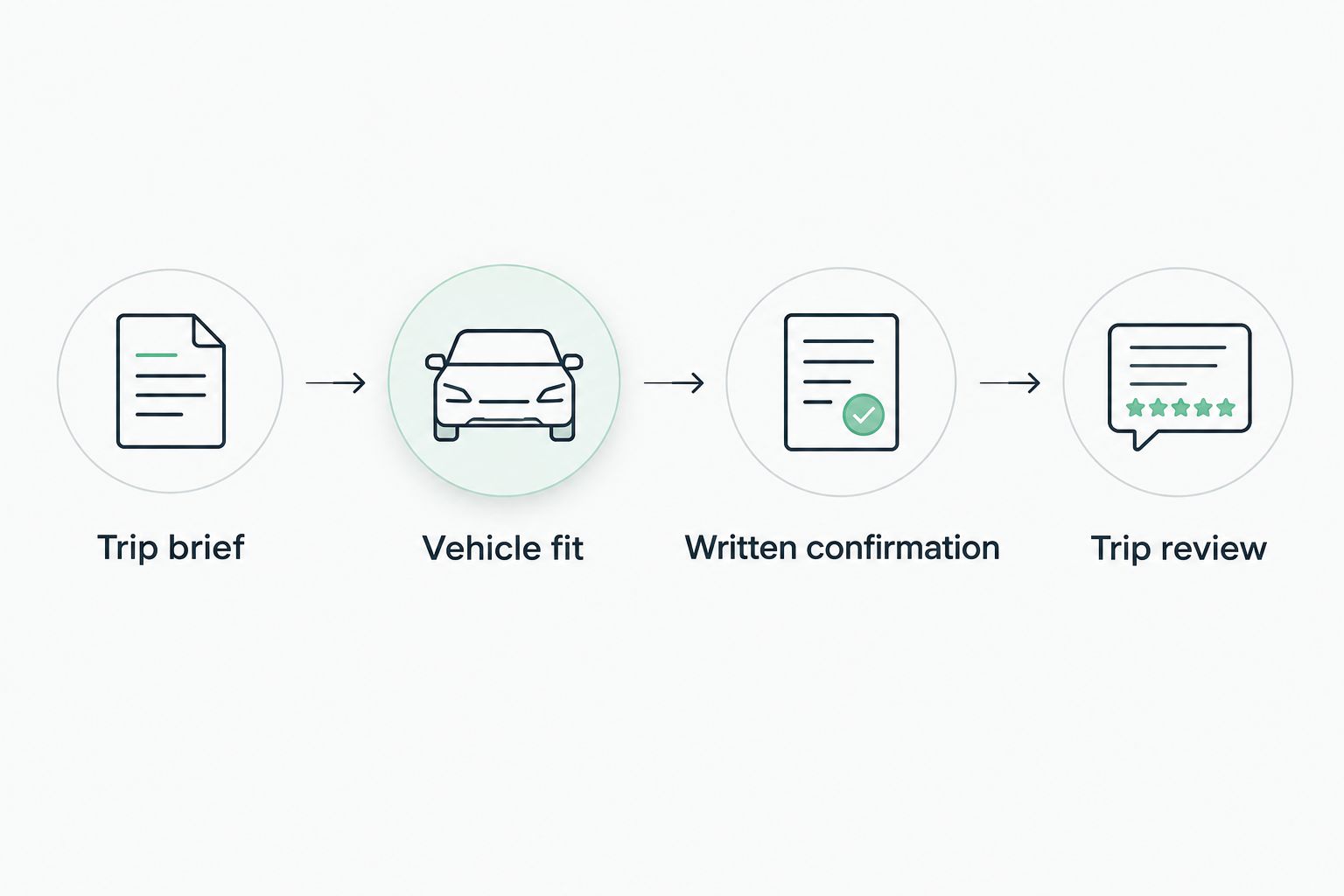
Define the trip before requesting transportation
Start with a reusable booking template in your existing document or calendar system. Record the appointment time separately from the requested arrival and pickup times. Those are 3 distinct times, and combining them into a single calendar entry hides decisions the booker still needs to make.
For a courthouse visit, identify the destination and check the relevant visitor instructions directly. Do not ask the chauffeur to determine courtroom access or screening requirements. Those are separate from the vehicle journey.
Your 2026 template should capture the operational details without becoming a case summary. Give the provider enough information to perform the trip, while keeping legal strategy and confidential documents outside the booking.
- Record the appointment time, requested arrival time, and pickup time separately.
- Confirm the destination address and intended passenger entrance.
- Specify whether the return journey is fixed or unresolved.
- List passengers, luggage, and any document containers.
- Name the person authorized to approve itinerary changes.
Map pickup, arrival, and return as separate tasks
Use a calendar and a written itinerary to map each stage manually. For airport arrivals, distinguish the flight’s arrival from the time the passenger expects to be ready for collection. For court appearances, distinguish the building arrival from the appointment itself.
Work backward from the required arrival using current routing information and the destination’s access instructions. No generic travel allowance can replace checking the actual journey. Build the return around the known schedule, not an assumed hearing or meeting finish.
Where the finish remains uncertain, ask the provider to explain the return options and how changes are handled. Do not leave the return leg implied. A booked outbound transfer does not establish what happens afterward.
- Check the route for the planned day and departure time.
- Confirm the pickup location with the traveler.
- Verify the destination entrance before sharing instructions.
- Document the arrangement for an uncertain finish.
- Separate airport collection instructions from flight details.
Match the vehicle to the working requirements
First, compare the passenger list and baggage in your booking template. Then ask the provider to confirm a suitable vehicle configuration. A vehicle category alone does not establish usable luggage space, seating layout, or accessibility for your particular trip.
Blacklimoboston chauffeur service includes sedans, SUVs, Sprinter vans, and limousines. Use that choice to request a vehicle matched to the journey rather than selecting by appearance. For a legal team, keeping people and materials together can be useful; it does not replace checking the actual configuration.
For 2026 bookings, document the confirmed vehicle category and any essential requirements. If a passenger needs particular boarding assistance or accessible transportation, explain the requirement explicitly and obtain confirmation before approving the arrangement.
- State the passenger count rather than requesting a vaguely sized vehicle.
- Describe luggage and document containers separately.
- Ask for confirmation of the proposed seating and baggage arrangement.
- Identify boarding or accessibility requirements before booking.
- Confirm how a vehicle substitution would be communicated.
Limit the information shared with the provider
Create neutral trip labels in your calendar or booking document. An office address and passenger contact details generally serve a transportation purpose; a description of litigation strategy does not. Avoid placing matter narratives in reservation notes merely because the field is available.
A private vehicle is not a substitute for your firm’s confidentiality procedures. Do not assume conversations, screens, or papers are protected simply because the ride is prearranged. Follow your firm’s rules for discussing client matters outside controlled premises.
Ask the provider how passenger information is handled and who receives trip instructions. Treat any confidentiality commitment as something to confirm, not a feature automatically included with a luxury vehicle.
- Use a neutral trip reference instead of a detailed matter description.
- Share only the contacts needed to operate the journey.
- Keep case documents out of reservation attachments.
- Ask who can access passenger and itinerary information.
- Remind travelers to secure papers and screens during the ride.
Assign ownership of changes and escalation
Use 1 primary coordinator for booking decisions and identify a backup contact. This keeps the traveler from receiving competing instructions from an assistant, an office manager, and another member of the legal team.
Request the provider’s process for delays, changed destinations, missed connections, and uncertain return times. Ask who the traveler should contact and who can authorize an amended journey. Record the answers with the booking rather than relying on a conversation that nobody else can see.
For your 2026 travel procedure, separate a routine update from a change requiring approval. A passenger sharing readiness for pickup is different from adding another destination. Your firm should decide who controls each decision.
- Name the primary coordinator and backup contact.
- Confirm the provider’s day-of-travel contact method.
- Identify who can approve extra stops or itinerary changes.
- Ask how updates reach both the traveler and the booker.
- Record the escalation process in the itinerary.
Verify the reservation before the travel day
Compare the provider’s written confirmation against your original brief. Read it as instructions for someone who has never seen the trip before. If the pickup location, return arrangement, or passenger contact remains unclear, resolve it before circulating the itinerary.
Review the terms governing amendments, waiting, cancellations, and additional stops. Do not assume that two providers use the same definitions or procedures. Written confirmation is useful because it identifies what was agreed, not because it removes every possible disruption.
Check 2 contact routes: the traveler’s way to reach the provider and the coordinator’s way to manage a change. Keep the confirmed itinerary accessible without attaching unrelated client materials.
- Match the date, pickup location, and destination against the brief.
- Verify passenger and coordinator contact details.
- Review the confirmed vehicle requirements.
- Read the terms for waiting, changes, and cancellation.
- Send the same final itinerary to the relevant participants.
Review the trip against the agreed instructions
Use a simple spreadsheet or shared log after the journey. Record observable events rather than broad impressions: whether the pickup instructions were understood, whether the confirmed vehicle requirements were met, and whether changes reached the right person.
Distinguish a booking failure from an itinerary change. If an attorney leaves a meeting later than planned, record that separately from a provider arriving after the agreed pickup. Otherwise, your review will not identify which part of the process needs correction.
Keep the 2026 log operational. It should help your firm decide whether to reuse a booking pattern or revise instructions, without becoming another repository for client information.
- Compare the actual pickup with the agreed arrangement.
- Record whether passengers and luggage fit as confirmed.
- Note how itinerary changes were communicated.
- Separate provider issues from traveler-requested changes.
- Update the booking template when a recurring problem appears.
Compare transportation options for legal travel
Choose the option that fits the assignment, not the most formal-looking vehicle. Prearranged chauffeur transportation suits a trip that needs advance coordination. Other options serve different purposes, but each leaves specific responsibilities with your firm.
| Option | Best for | Practical advantage | Key limitation |
|---|---|---|---|
| Prearranged chauffeur service | Client travel and coordinated legal itineraries | Lets your firm agree trip instructions before departure | Special requirements and change procedures still need confirmation |
| Taxi | A straightforward journey without a detailed itinerary | Keeps the arrangement focused on the immediate trip | Your firm still needs a separate plan for return travel and coordination |
| App-booked ride | A traveler managing an individual point-to-point journey | Places booking control with the traveler | Does not replace a firm-wide approval or itinerary process |
| Attorney-driven vehicle | A traveler who needs direct control of the vehicle | Keeps vehicle access with the attorney | The attorney also handles driving, parking, and vehicle logistics |
| Public transportation | A traveler whose route and schedule fit the service | Removes the need to arrange a private vehicle | Transfers, walking, and carrying materials remain part of the journey |
Within chauffeur transportation, choose the vehicle after defining the trip. A larger vehicle is not automatically a better fit, and a sedan is not automatically suitable just because the passenger list is short. Baggage, boarding needs, and the confirmed layout remain decisive.
Common mistakes Boston law firms make
Treating a courthouse address as complete instructions
A street address does not establish where the passenger should enter or how to reach the appointment. Confirm visitor access separately, then give the provider the appropriate passenger destination without promising access to restricted areas.
Assuming a hearing will finish on schedule
An unresolved finish creates an unresolved return journey. State that uncertainty when requesting transportation and agree how the traveler or coordinator will communicate readiness.
Putting case details into booking notes
Transportation instructions should explain the journey, not the matter. Replace narrative descriptions with neutral references and retain sensitive information in the firm’s approved systems.
Choosing a vehicle from passenger count alone
People are only part of the space requirement. Include luggage, presentation materials, and document containers when requesting confirmation of vehicle fit.
Accepting verbal changes without updating the itinerary
A revised pickup shared with only one person creates conflicting instructions. Have the authorized coordinator circulate the confirmed change to the traveler and provider.
FAQ
What is the best chauffeur service arrangement for a Boston law firm?
The best arrangement matches the legal itinerary, passenger requirements, and responsibility for changes. Blacklimoboston provides chauffeur-driven corporate transportation throughout Boston and New England; confirm the procedures and vehicle requirements for your booking.
Can a chauffeur service handle a court appearance with an uncertain finish?
An uncertain finish needs an expressly agreed return arrangement. Ask the provider how readiness, waiting, and itinerary changes are handled before confirming the outbound journey.
Should our law firm book a sedan, SUV, or Sprinter van?
Choose the vehicle after confirming passengers, luggage, document containers, and boarding requirements. Ask the provider to verify the proposed configuration rather than assuming capacity from the category name.
Is a chauffeured vehicle confidential enough for client discussions?
Do not treat a chauffeured vehicle as a guarantee of confidentiality. Follow your firm's information-handling rules and ask the provider about passenger data and any specific confidentiality commitments.
What should we send when booking airport transportation for an attorney?
Send the flight details, passenger contact, destination, luggage requirements, and agreed collection instructions. Distinguish flight arrival from passenger readiness and confirm the process for flight changes.
Is chauffeur service better than a taxi for legal travel?
Chauffeur service fits trips that require advance coordination, while a taxi fits a straightforward immediate journey. Decide based on the itinerary and the responsibilities your firm needs to settle before departure.
Who should manage transportation changes for a legal team?
Assign a primary coordinator and identify a backup contact. Give the provider clear instructions about who can approve changed destinations, extra stops, and revised pickup arrangements.
One last thing
Ask the traveler to read the pickup instructions without explanation. If the traveler cannot identify where to stand, whom to contact, and what to do when the schedule changes, the reservation is not ready to circulate. A short, usable itinerary is more valuable than a long booking email.