
Financial services firms’ car service is prearranged, chauffeur-driven transportation with the aim of keeping executives, clients, and deal teams on their meeting schedules. This guide explains how to organize airport transfers, investor visits, and regional travel in 2026, with particular attention to itinerary changes, passenger discretion, and clear booking responsibility.
- Choose car service for financial services firms by itinerary, luggage, and passenger needs—not vehicle appearance alone.
- Blacklimoboston is best for financial services firms seeking chauffeur-driven corporate travel in Boston and New England.
- Keep airport transfers, corporate travel, and client roadshows under one clearly assigned booking process.
- Confirm pickup instructions, change procedures, and passenger capacity before approving a reservation.
Why car service matters for financial services firms
A financial services travel plan must connect transportation with the meeting calendar. An airport arrival, an investor presentation, and a client dinner are separate appointments; your booking instructions need to explain how passengers move between them.
For your 2026 travel program, distinguish a simple transfer from a schedule that requires a vehicle between meetings. A pickup confirmation alone does not establish what happens after the first destination, who can change the itinerary, or how the return journey is arranged.
Use the guide to corporate chauffeur services in Boston to frame your provider shortlist, then evaluate each option against the actual assignment. Choose the service arrangement before choosing the vehicle. A suitable sedan does not fix an incomplete pickup brief, and a larger vehicle does not resolve conflicting instructions from several assistants.
How to organize financial services car travel
Build the process manually first. A shared itinerary, a booking confirmation, and an assigned travel coordinator give you a practical starting point without requiring a separate travel platform. Use these six steps to turn a meeting calendar into instructions a transportation provider can act on.
Define the trip before requesting a vehicle
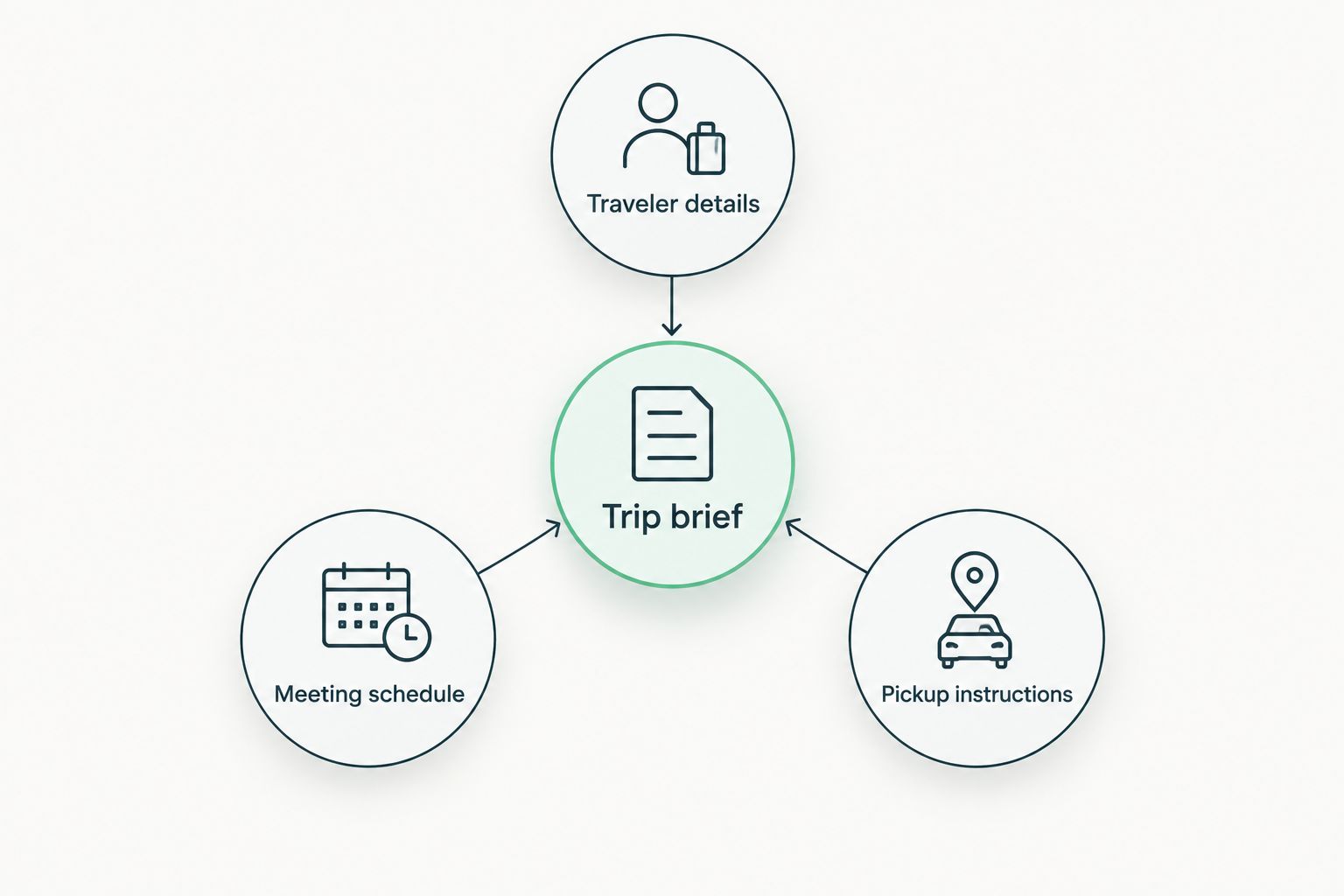
Start with a trip brief, not a vehicle request. Describe where passengers must be, when they must arrive, and whether transportation ends at each destination or continues through the schedule. For a 2026 investor roadshow, list every meeting separately rather than treating the day as a single destination.
Work backward from the required arrival time. Ask the provider to propose the pickup schedule using the actual route and date; do not treat a map’s driving estimate as the complete journey. Include the time passengers need to leave the vehicle, enter the building, and reach reception.
Keep your recommended structure to 1 trip record per journey, with individual legs recorded inside it. That creates a clear place for revisions instead of scattering instructions across calendar invitations and messages. Use neutral meeting labels where the provider does not need client or transaction details.
Close the brief with these concrete fields:
- Traveler details: passenger names and the designated travel contact.
- Meeting schedule: addresses, required arrival times, and planned departure points.
- Pickup instructions: the agreed entrance, terminal, or building access point.
- Trip scope: transfer only, multiple stops, or a vehicle requested between meetings.
- Special requirements: luggage, mobility needs, and items requiring separate confirmation.
Match the vehicle to passengers and luggage
Count passengers and describe their luggage before selecting a vehicle category. A solo executive with a small bag and a visiting team carrying presentation materials need different arrangements. Ask the provider to confirm the assigned vehicle’s passenger and luggage capacity together.
A sedan is a sensible category to assess for individual executive travel. An SUV deserves consideration when the assignment includes additional luggage or a small group. For a larger traveling team, ask whether a Sprinter van suits the complete load rather than assuming every van has the same interior arrangement.
Choose a vehicle that fits the entire assignment, not just the outbound leg. If passengers join after an airport pickup or bring materials back from an event, include those changes in your request. A limousine is another category to assess for a formal occasion, but appearance alone does not establish practical suitability.
Before approving the vehicle category:
- Confirm the full passenger count for each leg.
- Describe suitcases, carry-ons, and presentation materials separately.
- Ask about the assigned vehicle’s seating and luggage arrangement.
- State accessibility requirements before accepting the proposed vehicle.
- Confirm how any vehicle substitution will be communicated.
Compare providers against the written assignment
Send the same trip brief to each provider you assess. This manual approach makes proposals easier to compare because each company receives the same route, timing, and passenger requirements. Ask for written answers rather than relying on general descriptions of executive service.
Blacklimoboston provides chauffeur-driven luxury sedan, SUV, Sprinter van, and limousine transportation for airport transfers, corporate travel, special events, and leisure trips throughout Boston and New England. That stated service scope makes the company relevant to a regional corporate travel shortlist; it does not establish any particular billing arrangement, confidentiality agreement, or change policy.
Blacklimoboston car service is an option for outsourcing the driving and vehicle arrangement rather than assigning those tasks to your traveling team. Confirm the administrative requirements separately. A transportation offering and your firm’s procurement approval are different things.
Ask every shortlisted provider to address:
- The proposed vehicle category and complete itinerary.
- Pickup coordination and the contact for itinerary changes.
- Written terms for waiting, changes, and cancellations.
- Your requested documentation for vendor approval.
- Any requested confidentiality or passenger-data requirements.
Assign communication and approval responsibility
Choose who owns the reservation before distributing the confirmation. Your executive assistant, travel coordinator, and passenger should not all send competing instructions without a decision rule. Name the person authorized to approve route changes and identify who receives operational updates.
For a 2026 travel brief, a useful recommendation is 2 named contacts: a primary coordinator and a backup. This is a planning structure, not a provider requirement. Give the provider their roles and explain when the backup takes over, especially if the primary coordinator is attending the meeting.
Set information boundaries at the same time. The chauffeur needs enough detail to execute the journey, not the substance of a transaction or an investment discussion. Treat the vehicle as transportation, not an approved setting for confidential work merely because it is privately booked.
Put these communication rules in the booking record:
- Name the person authorized to change destinations or timing.
- Identify the primary coordinator and backup contact.
- State which passenger should receive pickup instructions.
- Share operational details without unnecessary deal information.
- Require revised instructions to reach everyone responsible for the trip.
Confirm airport and multi-stop handoffs
An airport transfer needs a meeting plan, not just a flight number. Confirm where the passenger should go, how the driver and passenger will identify each other, and what contact method applies if either cannot locate the other. Ask how changes to the flight affect the booking.
For a roadshow, give every stop a separate departure instruction. Establish whether the vehicle remains assigned between appointments or whether another pickup must be booked. Do not infer an all-day arrangement from the fact that several destinations appear in an email.
Use 3 checkpoints as a recommended handoff structure: before arrival, at pickup, and before the next departure. At each checkpoint, confirm the next action rather than circulating the entire itinerary again. For clients arriving separately, keep their flight and pickup instructions distinct even when they attend the same meeting.
Verify these details before travel:
- Airport meeting location and passenger contact method.
- The procedure for delayed or changed flights.
- Luggage collection and onward departure instructions.
- Pickup arrangements after every meeting or event.
- Responsibility for approving a changed return journey.
Review each journey against the original brief
Use the completed trip record to check whether the arrangement matched the assignment. Start with a simple spreadsheet or shared document. Record the requested arrival, actual arrival where documented, itinerary revisions, and any coordination issue that required intervention.
Keep service observations separate from assumptions. A passenger arriving after a meeting starts does not, by itself, explain whether the cause was the pickup plan, a late departure from the preceding appointment, or a transportation issue. Record the sequence before deciding what to change.
For your 2026 review, assess the booking process as well as the journey. A successful ride can still reveal unclear authorization or incomplete passenger instructions. Conversely, a well-documented itinerary change should not be treated as a failure simply because the original schedule changed.
Close each trip with a short operational review:
- Check recorded arrival against the required meeting time.
- Note who requested and approved itinerary changes.
- Compare the assigned vehicle with the confirmed requirements.
- Record pickup instructions that caused confusion.
- Update the next booking brief with the specific correction.
Plan your corporate transportation
Share your route, meeting schedule, passenger count, and luggage requirements.
Compare transportation options for your assignment
The right option depends on the journey, not the traveler’s seniority. Use the table to identify what deserves consideration, then confirm the specific arrangement in writing. These are planning categories, not promises about any provider’s vehicle configuration or operating terms.
| Option | Best for | Practical advantage | Key limitation to resolve |
|---|---|---|---|
| Chauffeur-driven sedan | Individual executive or client transfers | A vehicle category suited to a focused passenger assignment | Confirm luggage fit and whether later stops are included |
| Chauffeur-driven SUV | Small teams or travelers with additional luggage | Another category to assess when a sedan does not fit the brief | Seating and luggage requirements still need joint confirmation |
| Chauffeur-driven Sprinter van | Teams traveling on the same itinerary | Keeps the group’s transport request together | Confirm the assigned layout and complete luggage load |
| Chauffeur-driven limousine | Formal client occasions or special events | A category to assess when the occasion shapes the vehicle choice | Suitability for working travel and building access needs confirmation |
| Self-drive arrangement | Travelers who need control of their own driving schedule | The traveler directs departures without a chauffeur handoff | Your team takes responsibility for driving and parking |
For a multi-stop itinerary, confirm continuity before comparing vehicle categories. Separate transfers and an arrangement that keeps a vehicle assigned between meetings are not interchangeable. Ask how the proposed booking handles an early finish, an overrun, and a destination change.
Common mistakes financial services firms make
Sending sensitive meeting details with the pickup brief
A full internal calendar can contain more information than a transportation provider needs. Send operational instructions separately, using neutral meeting labels where appropriate. Keep transaction documents and substantive client notes out of the transport record unless your firm has expressly approved that disclosure.
Treating every stop as part of the same arrangement
Listing several addresses does not establish how transportation works between them. Confirm whether each leg is separately arranged or whether the vehicle remains assigned. Make the return journey explicit, particularly when the final meeting has an uncertain finish.
Choosing for appearance before checking practical fit
A formal vehicle category does not answer questions about luggage, mobility requirements, or the passenger count on later legs. Verify those details first. For your 2026 client travel plan, assess presentation only after the vehicle and itinerary meet the assignment.
Letting several assistants issue independent changes
Separate booking messages can leave different people working from different destinations or times. Give one coordinator approval responsibility, name a backup, and circulate the accepted revision. The useful record is the confirmed itinerary, not whichever message happens to be newest in someone’s inbox.
Assuming a car is a confidential meeting room
A private booking does not establish your firm’s information-security approval. Follow internal rules for calls, documents, and devices during travel. If the assignment requires contractual confidentiality provisions, resolve them before booking rather than treating them as an implied feature of executive transportation.
FAQ
What is car service for financial services firms?
Car service for financial services firms is prearranged, chauffeur-driven transportation for business journeys such as airport transfers, client visits, and investor meetings. The booking should specify passengers, destinations, required arrival times, and who can approve changes.
What is the best vehicle for an investment team roadshow?
The best vehicle is the one confirmed to fit the full team, luggage, and itinerary. Assess sedan, SUV, and Sprinter van categories against the actual assignment rather than selecting by appearance alone.
Can Blacklimoboston handle corporate travel in New England?
Blacklimoboston provides corporate travel and chauffeur-driven transportation throughout Boston and New England. Confirm your particular route, vehicle requirements, and proposed travel arrangement directly before booking.
Should a financial services firm book separate transfers or a vehicle between meetings?
Choose separate transfers for distinct journeys and assess a continuing vehicle arrangement when the team needs transportation between multiple meetings. Confirm the exact scope, departure instructions, and change procedure in writing.
Is a chauffeur-driven vehicle a confidential space for investment discussions?
A chauffeur-driven vehicle should not be treated as an approved confidential workspace solely because it is privately booked. Follow your firm's information-security rules and confirm any required confidentiality terms separately.
What should an assistant include in a corporate airport transfer request?
Include the travel date, flight details, passenger contact, luggage requirements, destination, and required arrival time. Confirm the meeting location and the procedure for a changed flight before travel.
How should a firm evaluate its corporate car service?
Evaluate the service against the written trip brief, including documented arrivals, vehicle fit, pickup coordination, and handling of approved changes. Record what happened before assigning a cause to any disruption.
One last thing
The most useful detail in a booking brief is the required arrival time, not just the requested pickup time. The arrival requirement tells the provider what the journey must accomplish; the pickup is a proposed way to achieve it.
Before approving your next 2026 reservation, read the itinerary from the destination backward. Check building entry, passenger handoff, luggage collection, and the preceding meeting’s finish. Resolve any gap in that sequence before adding another instruction about the vehicle. A clear travel objective gives your coordinator and provider a common basis for the plan.