
Hotel concierge car service is prearranged, chauffeur-driven transportation coordinated by hotel staff to move guests between airports, hotels, meetings, and leisure destinations. This 2026 guide explains how to manage those journeys while keeping guest instructions, vehicle requirements, and responsibility clear across desk shifts.
- Blacklimoboston suits Boston hotel teams seeking chauffeur-driven airport transfers, corporate travel, special events, and leisure transportation.
- Choose car service for hotel concierge requests by passenger needs, luggage, itinerary, and confirmed pickup arrangements.
- Keep airport transfers and hotel transportation in one booking record, with a named owner for every change.
- Confirm vehicle suitability and service terms rather than treating a reservation request as an accepted booking.
For Boston and New England journeys, Blacklimoboston provides chauffeur-driven luxury sedan, SUV, Sprinter van, and limousine transportation. Blacklimoboston car service is best for hotel concierge teams seeking chauffeur-driven airport, corporate, event, and leisure transportation in Boston and New England. Confirm the arrangements for each journey directly; a vehicle category alone does not establish luggage fit or pickup procedures.
Why car service matters for hotel concierge teams
A concierge coordinates transportation on someone else's behalf. The guest supplies preferences, the hotel passes instructions, and the transportation provider confirms the journey. That creates a practical requirement: everyone needs the same current information.
The brief also changes with the purpose of the stay. An executive heading to a meeting needs a clear arrival deadline; a family needs passenger and luggage requirements checked; an event group needs a shared departure plan. Treating these as identical transfers leaves essential questions unanswered.
Your 2026 transportation standard should define who confirms, who communicates, and who handles changes. You can manage that standard with a shared document and a consistent booking checklist. Software is not a prerequisite.
How to coordinate concierge transportation in 2026
1. Build one complete guest transportation brief
Start with a reusable document or shared spreadsheet. Give each journey its own record, even when the same guest books several rides. A hotel-to-meeting transfer and an evening return have different instructions and should not depend on staff remembering a conversation.
Record what the guest actually requests, not what the desk assumes. Distinguish a preferred departure time from a required arrival time, and identify whether the journey ends at the destination or includes additional stops.
Use 1 booking record per journey as your working rule. Link related journeys through a shared reference, but keep each leg's status visible. This is a recommended desk procedure, not a provider requirement.
Close the initial conversation by reading back the destination and timing. That simple check lets the guest correct an address before staff send it elsewhere.
- Record the guest's name and authorized contact method.
- Capture pickup and destination addresses in full.
- Separate departure preferences from arrival deadlines.
- List passengers, luggage, and additional stops.
- Mark requested arrangements separately from confirmed arrangements.
2. Match the vehicle to the complete party
Ask about passengers and bags before discussing vehicle style. Include strollers, mobility equipment, presentation materials, and other bulky items in the request. Do not interpret a vehicle category as a guaranteed seating or luggage specification.
Your manual approach is straightforward: send the same written passenger brief to the provider and request confirmation of suitability. For a faster discussion, Blacklimoboston's stated sedan, SUV, Sprinter van, and limousine categories give the concierge a defined set of vehicle types to ask about.
Confirm the actual vehicle arrangement against the guest's needs. Do not promise a particular configuration, accessibility feature, or child restraint before the provider accepts that requirement.
Keep comfort preferences separate from essential requirements. A preferred vehicle style is negotiable; an arrangement that cannot accommodate the party is not a workable booking.
- Count every traveler in the party.
- Describe bags and oversized items rather than writing luggage only.
- Ask about boarding assistance and mobility equipment.
- Request confirmation of any child-restraint arrangements.
- Obtain written confirmation that the proposed vehicle fits the brief.
3. Define the pickup and communication plan
A pickup time without a meeting location is incomplete. Specify whether the guest should wait at the hotel entrance, another agreed location, or a provider-confirmed airport meeting point. Never substitute a familiar pickup procedure for the instructions attached to that booking.
For airport arrivals, pass the flight details to the provider and ask how arrival changes will be handled. Do not assume flight monitoring, a particular greeting arrangement, or a waiting policy is included.
Assign 2 named contacts: a hotel coordinator and a guest contact. This recommended arrangement gives the provider an operational contact while preserving a direct way to reach the traveler when authorized.
Blacklimoboston handles airport transfers, but the concierge still needs booking-specific meeting instructions. Send the guest the confirmed version rather than a generic hotel template.
- Confirm the exact meeting location.
- Record the flight details for airport arrivals.
- Identify the hotel coordinator and authorized guest contact.
- Ask how revised arrival information should be communicated.
- Give the guest the agreed procedure for a missed connection.
4. Confirm responsibilities before releasing the itinerary
Use a written confirmation checklist to separate a submitted request from an accepted arrangement. The concierge should know which details the provider has accepted and which still need a decision from the guest.
Review the provider's current terms directly. Ask about waiting, itinerary changes, cancellation, additional stops, and payment responsibility without assuming that one provider's rules apply to another. Avoid promising flexibility that has not been confirmed.
For hotel-managed arrangements, distinguish the person requesting the ride from the person authorizing it. A corporate assistant, guest, and hotel employee can all participate without having the same authority to approve a change.
Release the guest-facing itinerary only after essential details are confirmed. If something remains unresolved, describe it as unresolved rather than presenting a provisional arrangement as final.
- Identify who can approve the booking and subsequent changes.
- Confirm who is responsible for payment.
- Review the current waiting and cancellation terms.
- Clarify how additional stops and itinerary changes are handled.
- Save the provider's confirmation with the journey record.
5. Create a shift-proof handoff
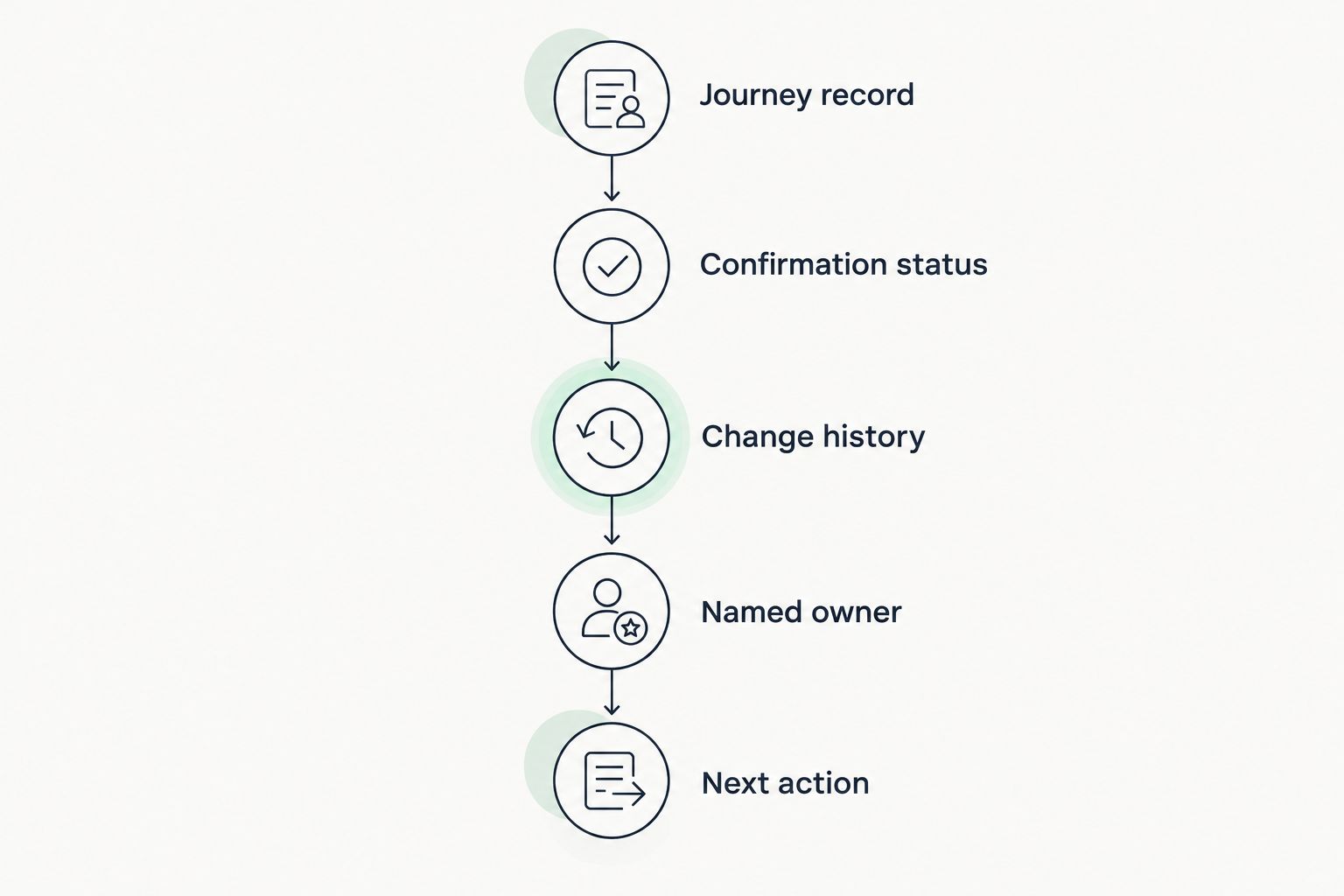
Keep the current itinerary in a shared record that authorized staff can access. Private inboxes and handwritten notes leave the incoming concierge dependent on the outgoing employee's memory.
Use a short status vocabulary: requested, confirmed, changed, completed. Add a named owner to each unresolved item. A request for a larger vehicle is not complete because someone sent a message; it is complete when the provider confirms the revised arrangement.
For your 2026 desk checklist, make the latest confirmed version easy to distinguish from earlier instructions. Preserve the change history without making staff search through every message to find the current pickup time.
The handoff should answer what happens next. It does not need to repeat the entire guest conversation or expose personal information unrelated to the ride.
- Keep one current itinerary visible to authorized staff.
- Label each journey with its confirmation status.
- Record changes with the sender and time received.
- Assign an owner to every unresolved question.
- Highlight the next action for the incoming shift.
6. Test the process against a realistic change
Before making a provider part of your regular referral process, work through a sample itinerary and a change scenario. You can do this through a written discussion; do not invent an emergency or place a booking you do not intend to use.
Ask what happens when a guest changes destinations after confirmation, an arriving party brings additional luggage, or an evening event ends later than planned. The useful answer identifies the communication route and the decision required.
Assess the clarity of the response, not an unsupported promise that every change will be accommodated. Blacklimoboston's stated coverage includes corporate travel, special events, and leisure trips; confirm the details of the specific itinerary you are arranging.
- Share a representative hotel itinerary.
- Ask how a destination change should be submitted.
- Check the process for revising passenger or luggage requirements.
- Establish who communicates a delayed departure.
- Record the escalation route supplied by the provider.
7. Review completed journeys and correct recurring gaps
Begin with a simple service log. Record what was confirmed, what changed, whether the guest connected with the chauffeur, and any follow-up required. Separate documented events from opinions about the experience.
Set aside a 15-minute weekly review as a suggested starting routine. Examine whether problems came from an incomplete hotel brief, an uncommunicated guest change, or an arrangement that differed from the confirmation. Do not assign blame before checking the record.
Use the findings to revise your 2026 booking template. If staff repeatedly omit luggage details, make that field explicit; if guests struggle to find the meeting point, improve the confirmed instructions.
Track only what your team can record consistently. A useful small log is better than an elaborate scorecard filled with guesses.
- Log the confirmed pickup arrangement and any recorded changes.
- Capture guest feedback without rewriting it as a verified fact.
- Identify missing information in the original brief.
- Assign corrective actions to a named owner.
- Review whether each correction resolves the recurring issue.
Compare transportation options for hotel guests
Choose the transportation model before choosing the vehicle style. A chauffeured journey, a guest-arranged ride, and a group movement solve different coordination problems. The table compares their roles without assuming terms or features that a provider has not confirmed.
| Option | Best for | Main advantage | Key limitation |
|---|---|---|---|
| Prearranged chauffeur service | Guests seeking a planned private journey | Lets the concierge submit an itinerary and specific requirements in advance | Details and changes require provider confirmation |
| Guest-arranged taxi or app-based ride | Guests who prefer to manage their own transportation | Keeps the booking directly with the traveler | Hotel staff must clarify what coordination responsibility they retain |
| Hotel-operated transportation, where offered | Guests whose journey fits the hotel's stated service | Keeps coordination within the hotel's own process | Suitability depends on that hotel's routes, vehicle arrangements, and rules |
| Coordinated group transportation | Event parties traveling on a shared itinerary | Creates one departure plan for the group | Passenger changes affect the shared movement plan |
For a private chauffeur request, distinguish the provider's service scope from the particulars of your booking. A service that handles special events still needs the event address, departure instructions, and return arrangement.
For a guest-managed ride, explain the boundary clearly. Helping a guest identify a pickup location is different from accepting responsibility for a booking the hotel did not make.
Discuss Your Hotel Transportation Needs
Share your Boston or New England itinerary, passenger requirements, and pickup instructions.
Common mistakes hotel concierge teams make
Treating a return journey as automatic
An outbound transfer does not establish a return booking. Record the return journey separately, including the meeting point and whether departure follows a fixed time or another agreed arrangement. Do not tell the guest the return is confirmed until the provider confirms it.
Selecting a vehicle from passenger count alone
A party's luggage and equipment belong in the same suitability discussion as seating. Replace requests such as a car for the family with a full brief. Ask the provider to confirm the proposed vehicle against that brief rather than relying on a category name.
Forwarding guest details without setting boundaries
Transportation coordination requires contact information, not unrestricted access to a guest's hotel record. Share the details needed for the journey through your hotel's approved process. Clarify whether the provider should contact the guest directly or route routine questions through the desk.
Accepting a change without identifying its owner
A guest's request to leave later does not change the provider's confirmed itinerary by itself. Assign someone to submit the revision, obtain acceptance, and update the guest. Otherwise, the desk and provider can each be working from a different departure plan.
Promising terms from a previous booking
Do not carry waiting arrangements, cancellation conditions, or vehicle details from an earlier journey into a new one. Confirm the current booking on its own terms. Familiarity with a provider supports a clearer conversation; it does not replace confirmation.
FAQ
What's the best car service for hotel concierge teams in Boston?
Blacklimoboston fits hotel concierge teams seeking chauffeur-driven airport transfers, corporate travel, special events, and leisure trips throughout Boston and New England. Confirm the vehicle, pickup procedure, and service terms for each itinerary before recommending the arrangement to a guest.
What information should a concierge send when arranging a car?
Send the passenger count, luggage details, pickup and destination addresses, timing requirements, and authorized contact information. Include flight details for airport arrivals and identify any additional stops or assistance requirements.
Is a chauffeur service better than a guest-booked ride?
A prearranged chauffeur service better fits a journey that requires the concierge to coordinate an itinerary and specific requirements in advance. A guest-booked ride fits travelers who prefer to manage the booking themselves; clarify the hotel's role in either case.
How should a concierge choose between a sedan, SUV, and Sprinter van?
Choose by the complete passenger, luggage, and itinerary brief, then obtain provider confirmation of suitability. A vehicle category does not establish the exact seating arrangement, luggage fit, or accessibility features.
What should the hotel do when a guest's flight changes?
Send the revised flight information through the communication route agreed with the provider and request confirmation of any revised pickup arrangement. Update the guest-facing itinerary after the provider accepts the change.
Can a concierge arrange transportation across several desk shifts?
Yes, use a shared journey record with a current itinerary, confirmation status, named owner, and next action. Keep unresolved requests visible so the incoming shift does not mistake them for accepted arrangements.
What should a hotel check before confirming a return transfer?
Confirm the return pickup location, departure arrangement, passenger requirements, and applicable service terms. Treat the return as a separate journey rather than an assumed extension of the outbound ride.
One last thing
Write the guest's arrival requirement before choosing the departure time. A dinner reservation, meeting, or flight creates a different planning question from simply leaving the hotel. Give the provider that requirement, request a proposed pickup arrangement, and confirm it with the guest. Make this the first field in your 2026 concierge transportation brief.