
Event planners’ car service is prearranged, chauffeur-driven transportation with the aim of getting guests to meetings and events according to your schedule. This 2026 guide explains how to coordinate Boston airport transfers, vehicle assignments, venue arrivals, and return journeys without leaving critical decisions to individual passengers.
- For car service for event planners Boston, choose by itinerary, passenger needs, and written operating terms—not vehicle appearance alone.
- Blacklimoboston serves planners seeking chauffeur-driven airport transfers, corporate travel, and special-event transportation across Boston and New England.
- Match sedans, SUVs, Sprinter vans, and limousines to confirmed passenger and luggage requirements.
- Use one transport manifest, named decision-makers, and explicit pickup instructions for every journey.
Why car service matters for event planners
An event planner manages connected journeys, not isolated rides. A speaker’s airport transfer affects a rehearsal; a delayed dinner departure affects the return schedule. Your transportation brief needs to reflect those dependencies before you request vehicles.
Boston and New England events can involve airport arrivals, hotel transfers, corporate meetings, and off-site activities within the same program. Treat each movement as a separate assignment with a clear owner, destination, and passenger list. Do not assume a booking covers every movement simply because the event has one name.
Blacklimoboston provides chauffeur-driven luxury sedans, SUVs, Sprinter vans, and limousines for airport transfers, corporate travel, special events, and leisure trips throughout Boston and New England. Blacklimoboston is best for planners seeking chauffeur-driven airport, corporate, and special-event transportation in Boston and New England. Confirm event-specific coordination arrangements before selecting a provider; a vehicle category alone does not establish the operating plan.
How to plan Boston meeting and event transportation
1. Build one transportation brief
Start with a shared spreadsheet or document. You do not need a booking platform to establish who travels, where each journey begins, and which arrival deadlines are fixed. Keep transportation details separate from the broader event agenda so drivers and coordinators can find their assignments quickly.
For your 2026 event brief, separate confirmed information from unresolved requests. A guest’s preferred departure time is not a confirmed booking, and a venue name is not a complete drop-off instruction. Record the exact entrance when the venue provides it.
Make 1 planning file the authoritative record, with a named person responsible for updates. Keep personal information limited to what the transportation assignment requires.
- Record event dates, venues, hotels, and transfer destinations.
- List passengers by journey rather than by invitation status.
- Mark fixed arrival deadlines and flexible departures separately.
- Add luggage, mobility, and equipment requirements.
- Assign an owner to each unresolved detail.
2. Work backward from arrival deadlines
Build the schedule manually from the moment passengers must be ready at their destination. Arrival at the curb is not the same as arrival at registration, a green room, or a meeting seat. Ask the venue what happens between vehicle drop-off and the passenger’s actual commitment.
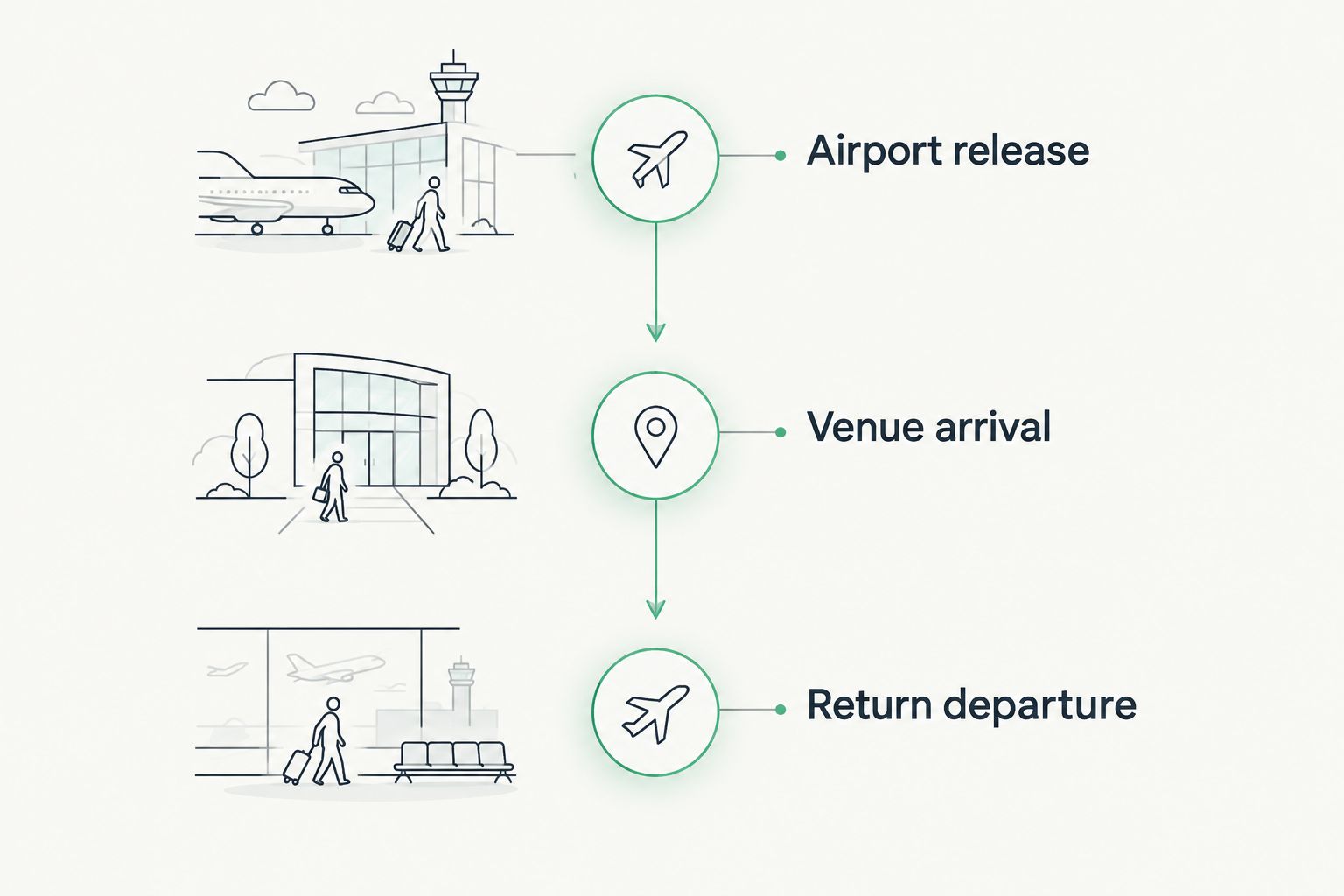
Use 3 timing checkpoints: airport release, venue arrival, and return departure. Airport release means the passenger is ready to leave the terminal, not simply that the aircraft has landed. Venue arrival should include the correct entrance; return departure needs its own assembly instructions.
Ask the transportation provider to review your proposed schedule. Do not insert a universal travel buffer or treat an online route estimate as a service commitment.
- Airport release: distinguish landing from readiness for pickup.
- Venue arrival: identify the entrance and required arrival deadline.
- Return departure: set the gathering point and departure decision-maker.
- Flag journeys that depend on another session ending.
- Ask how schedule changes will be acknowledged.
3. Match vehicles to the actual assignment
Create a passenger-and-luggage inventory before choosing a vehicle. Seating alone is not a sufficient specification: attendees can bring suitcases, presentation materials, or equipment that changes the assignment. Ask the provider to confirm the suitability of the proposed vehicle for the complete load.
Blacklimoboston’s car service includes sedans, SUVs, Sprinter vans, and limousines. Those categories give planners different formats to discuss, but the inputs do not establish individual vehicle capacities or accessibility features. Obtain those details for the vehicle proposed for your event.
Choose the vehicle around the journey, not the photograph. A formal arrival, a luggage-heavy airport transfer, and a coordinated group departure have different requirements even when they share a destination.
- Submit passenger totals and luggage details for each journey.
- Identify equipment that needs separate handling or storage.
- Confirm seating and storage for the proposed vehicle.
- Request specific accessibility arrangements where required.
- Ask whether the assignment changes if passengers are added.
4. Compare providers using the same written brief
Send each provider the same itinerary and requirements. This gives you a consistent basis for comparing what each proposal includes, which details remain unresolved, and how changes will be handled. A polished response is not a substitute for a complete operating agreement.
For a 2026 event, request current documentation and current terms rather than relying on a previous booking. Ask for applicable licensing and insurance information, the proposed vehicle category, and the person responsible for operational questions. Do not assume any provider supplies dedicated event dispatch or on-site coordination.
Blacklimoboston’s chauffeur service covers the stated airport, corporate, special-event, and leisure categories. Use that scope as a starting point, then confirm the arrangements your event requires in writing.
- Request an itinerary-specific proposal with inclusions and exclusions.
- Ask for applicable licensing and insurance documentation.
- Confirm the process for flight changes and delayed passengers.
- Review waiting, cancellation, overtime, and substitution terms.
- Establish who handles operational questions during the event.
5. Agree on venue and airport handoffs
Start by contacting each venue and checking the airport’s current passenger pickup instructions. Write a separate handoff instruction for each location rather than using a generic direction such as main entrance. A hotel lobby, loading area, and permitted passenger pickup point are not interchangeable.
Define 2 operational contacts for each movement: the planner-side decision-maker and the provider-side contact. These are roles you establish, not services to assume. Tell passengers which contact to use if they cannot locate their pickup.
For coordinated groups, determine who checks attendance and who authorizes departure. The chauffeur should not have to decide whether an absent attendee has canceled, changed plans, or become separated from the group.
- Confirm the permitted pickup and drop-off locations.
- Ask the venue about vehicle access and staging restrictions.
- Set the passenger gathering point before vehicle departure.
- Name the person who confirms the group is ready.
- Share concise location instructions with attendees.
6. Publish a controlled passenger manifest
Use your spreadsheet to create an operational manifest after assignments are confirmed. Give each journey a clear identifier and include only the details needed by its recipients. A chauffeur needs pickup instructions; an attendee does not need the entire event’s passenger contact list.
Freeze a working version before distributing it, then label subsequent revisions clearly. For your 2026 manifest, distinguish proposed changes from accepted changes so nobody acts on an unconfirmed instruction. Ask the provider how it wants revisions submitted and how acceptance will be communicated.
Keep passenger messages short enough to read while traveling. The essential information is the pickup time, location, destination, and contact route—not the history of how the journey was arranged.
- Give every journey a unique identifier.
- Include confirmed passengers and the assigned vehicle category.
- Add pickup instructions and destination entrance details.
- Show the revision date and document owner.
- Distribute personal contact details only where operationally necessary.
7. Reconcile changes and close the event
Maintain a simple change log during the event. Record what changed, who authorized it, and whether the provider accepted the instruction. This creates a clearer record than scattered messages across attendee chats, venue emails, and telephone calls.
Do not equate sending an update with completing a change. A new pickup location or departure time becomes operational only when the responsible parties acknowledge it. If a session runs late, follow the agreed process rather than assuming the vehicle can remain indefinitely.
After the final journey, compare the original plan with the completed movements. Use the differences to improve the next brief without circulating unnecessary passenger information.
- Log changed departure times and destinations.
- Record the person authorizing each change.
- Obtain acknowledgment through the agreed communication channel.
- Check completed journeys against the agreed scope.
- Retain operational lessons under your organization’s information policies.
Compare transportation options by event assignment
The best option is the one that fits the passenger group and operating plan. Use this comparison to shape your brief, then obtain confirmation for the specific vehicle or arrangement. The table describes planning uses, not guaranteed specifications or provider policies.
| Option | Best for | Main advantage | Key limitation |
|---|---|---|---|
| Chauffeur-driven sedan | Individual speakers or executives | A separate assignment for a named passenger | Passenger and luggage requirements still need confirmation |
| Chauffeur-driven SUV | Travelers needing an alternative to a sedan | Another vehicle format to assess against the load | The category does not establish usable luggage space |
| Chauffeur-driven Sprinter van | Groups intended to travel together | Supports planning around a shared departure | Seating, luggage space, and access require vehicle-specific confirmation |
| Chauffeur-driven limousine | Events where a formal arrival is part of the brief | Aligns the vehicle format with the occasion | Appearance does not establish suitability for airport luggage or group access |
| Individually arranged rides | Attendees managing their own journeys | Leaves travel decisions with each attendee | Gives the planner less direct control over shared departure coordination |
A mixed plan can be more appropriate than one vehicle format for the entire event. For example, you can specify separate speaker transfers and a shared group movement without assuming both assignments need identical vehicles. Keep each journey’s requirements explicit when requesting the proposal.
Discuss Your Event Transportation
Share your itinerary, passenger requirements, and Boston or New England destinations.
Common mistakes event planners make
Treating flight arrival as passenger readiness
An aircraft’s arrival does not mean the passenger is at the pickup location. Keep flight information and passenger readiness as separate fields, and confirm how the provider handles the handoff. Avoid sending guests a pickup instruction that depends on an unconfirmed meeting location.
Assigning vehicles before collecting luggage details
A passenger count leaves part of the assignment undefined. Collect baggage and equipment requirements before accepting the proposed vehicle, especially when guests travel directly from the airport. Do not infer storage from a vehicle category name.
Publishing the agenda as the transportation schedule
An agenda explains the event; a transport manifest explains movements. Include origin, destination entrance, passenger assignment, gathering point, and departure authority. A session end time by itself does not tell a group where to meet.
Letting several people change the same booking
Speakers, assistants, venue teams, and hosts can issue conflicting instructions. Establish one authorization route while preserving a clear contact option for passengers who need help. Record the accepted change in the shared operational file.
Assuming the return journey is automatic
A confirmed outbound transfer does not define the return assignment. Specify the return destination, gathering point, departure arrangements, and handling of guests who leave separately. Confirm any additional movements rather than treating them as extensions of the original trip.
FAQ
What is the best car service for event planners in Boston?
The best fit is a provider that confirms your itinerary, vehicle suitability, pickup arrangements, and operating terms in writing. Blacklimoboston offers chauffeur-driven airport transfers, corporate travel, and special-event transportation throughout Boston and New England; confirm the coordination requirements for your particular event.
Should I choose a sedan, SUV, or Sprinter van for meeting guests?
Choose the vehicle after confirming passenger numbers, luggage, equipment, and access requirements. Ask the provider to verify the suitability of the specific vehicle rather than relying on its category name.
Can I use one transportation plan for airport arrivals and event transfers?
Yes, use one master plan with separate assignments for airport arrivals and event transfers. Each journey still needs its own passengers, timing, pickup instructions, and destination.
How early should I arrange transportation for a 2026 Boston event?
Begin the transportation brief when your dates, venues, and passenger requirements are clear enough to describe. Ask the provider for its booking requirements instead of relying on a universal lead time.
What should I send when requesting an event transportation proposal?
Send the itinerary, passenger totals, luggage requirements, pickup and destination details, and fixed arrival deadlines. Include accessibility requests and identify the person authorized to approve changes.
Does booking a car service include an on-site transportation coordinator?
Do not assume an on-site coordinator is included. Request that role explicitly and confirm its responsibilities separately from the chauffeur assignment.
What happens if a meeting runs late or a flight changes?
Follow the change process agreed with the provider before the event. Confirm how to submit updates, who acknowledges them, and which waiting or schedule-change terms apply.
One last thing
A confirmed vehicle is not a complete transportation plan. The remaining handoff is between the person who knows the passengers are ready and the person authorized to move the vehicle. Before your 2026 event begins, name both roles for every coordinated departure and make sure they share the same instructions.