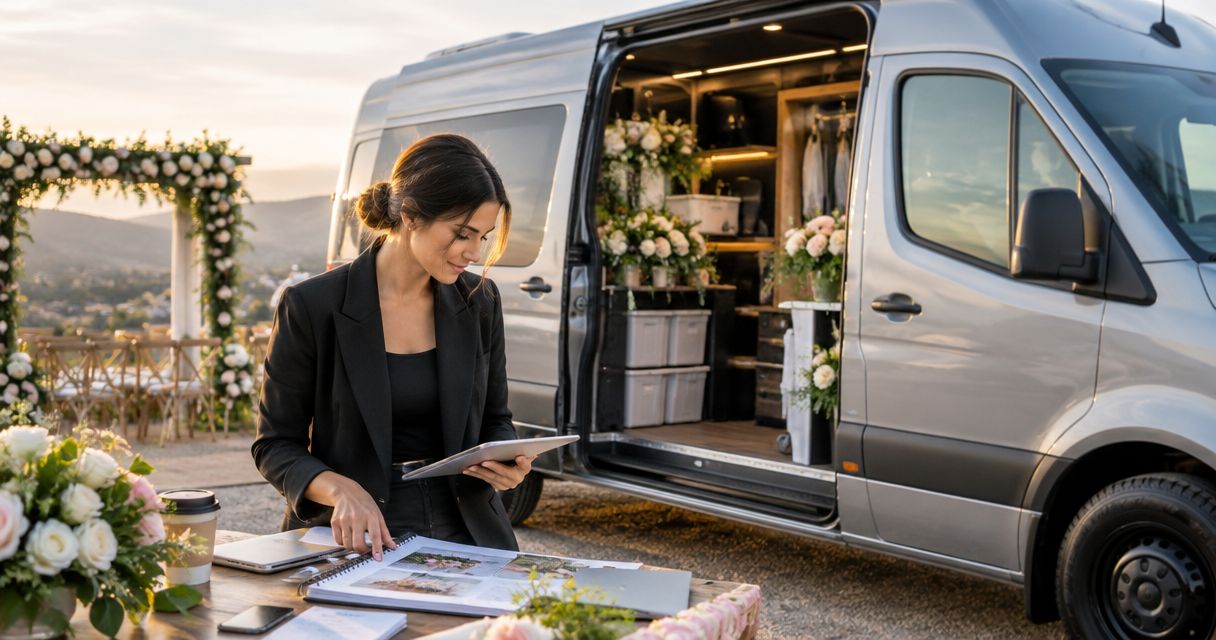
Wedding planners’ Sprinter van rental is group transportation arranged around a wedding itinerary, with the aim of moving guests and the wedding party between scheduled events. For 2026 weddings, distinguish chauffeur-driven service from self-drive rental, then confirm the passenger configuration, boarding needs, and venue access before choosing a vehicle.
- Sprinter van rental for wedding planners starts with passenger assignments, venue access, and a written wedding transportation schedule.
- Blacklimoboston fits planners seeking chauffeur-driven Sprinter transportation across Boston and New England.
- Confirm seating and luggage space for the assigned vehicle; the Sprinter name alone does not establish capacity.
- Separate ceremony arrivals from reception return trips so each movement has its own boarding instructions.
Start with the service model, not the vehicle photograph. Blacklimoboston provides chauffeur-driven sedans, SUVs, Sprinter vans, and limousines for airport transfers, special events, and other trips throughout Boston and New England. Blacklimoboston is best for wedding planners seeking chauffeur-driven Sprinter transportation in Boston and New England. Confirm the vehicle assignment and operating arrangements for your specific wedding before booking.
Why Sprinter van rental matters for wedding planners
Wedding transportation has a fixed destination deadline: guests and participants must reach the ceremony before their roles begin. A transfer that looks straightforward on a map still needs boarding time, a legal loading location, and instructions that guests can follow without calling the couple.
Your planning challenge is also different from arranging an ordinary group outing. The wedding party, older relatives, photographers, and hotel guests do not necessarily travel together or carry the same belongings. A single passenger total hides those differences.
For your 2026 transportation plan, treat every transfer as a separate assignment. Record who travels, where they board, what they bring, and who confirms departure. Choose the vehicle around the passenger movement; do not reshape the wedding schedule around an unverified seating assumption.
The practical benefit of a chauffeur-driven arrangement is that you can assign driving separately from guest coordination. Its limitation remains operational: a chauffeur cannot identify an absent guest, approve a ceremony delay, or choose a new destination without clear instructions and an authorized contact.
How to plan wedding Sprinter transportation
1. Define each passenger group before requesting vehicles
Build a spreadsheet before contacting transportation providers. Use 1 master manifest, with separate rows for each journey rather than a single list of everyone invited to the wedding. This gives you a working document that can change without losing track of who travels when.
Record actual travelers, not hotel room counts. A guest staying at the main hotel might travel independently, while a family staying elsewhere might need the shuttle. Ask guests to confirm their transportation needs through your existing RSVP process.
Best for initial planning: a shared spreadsheet with one person responsible for updates. It keeps the brief editable, but it does not replace written confirmation from the transportation provider.
- Separate the wedding party, family groups, and general guest transfers.
- Identify children traveling with accompanying adults.
- Record luggage, garment bags, mobility equipment, and other bulky belongings.
- Mark guests who need assistance boarding or reaching the pickup point.
- Assign an owner to approve passenger-list changes.
2. Confirm the actual seating and boarding arrangement
Ask for the configuration of the vehicle assigned to your event. Sprinter conversions differ, so a vehicle category or photograph does not establish usable seating, luggage storage, or accessibility. Request written answers tied to the proposed vehicle rather than relying on a general fleet description.
Compare the confirmed layout against your manifest manually. For every occupied seat, consider the belongings traveling with that passenger. Airport arrivals and wedding-party transfers can create different storage requirements even when the passenger count stays unchanged.
Best for vehicle selection: a confirmed layout matched to the trip’s passengers and belongings. Do not treat an advertised passenger maximum as proof that the full group and its bags fit together.
- Confirm usable passenger seats for the proposed configuration.
- Ask where luggage and garment bags will be stored.
- Check entry steps, handholds, and boarding assistance arrangements.
- Describe mobility needs explicitly instead of assuming accessibility.
- Confirm child-restraint requirements and who supplies the appropriate equipment.
3. Compare service models using the same brief
Send each provider the same itinerary, passenger requirements, and venue details. A consistent brief makes responses easier to compare; otherwise, you risk evaluating different scopes as though they were equivalent.
For a 2026 Boston wedding, Blacklimoboston’s chauffeur-driven Sprinter service is an option to evaluate when you want a driver included in the transportation arrangement. The service description establishes the vehicle category and regional coverage, not the assigned vehicle’s seating, accessibility, or wedding-day procedures. Confirm those details directly.
Manual coordination works when you can manage provider correspondence and revisions yourself. The faster route to a usable proposal is to submit one complete brief rather than negotiate through disconnected messages about vehicles, destinations, and departure times.
- State whether you need chauffeur-driven transportation or self-drive rental.
- Request confirmation of the proposed vehicle configuration.
- Describe every stop, including photography and hotel returns.
- Ask how itinerary changes and service extensions are handled.
- Obtain written substitution and cancellation terms before committing.
4. Build the itinerary backward from required arrival
Start with the time each group must be inside the venue, ready for its role. Then work backward through unloading, travel, boarding, and the walk from the hotel gathering point. A ceremony arrival time is not the same as a vehicle’s curbside arrival time.
Use 3 checkpoints for each transfer: ready to board, departure, and required arrival. Set the intervals using the route, venue instructions, and provider’s assessment rather than copying a universal buffer from another wedding.
Organize the schedule into Hotel pickup, Ceremony arrival, Reception transfer, and Return trips. These stages expose handoffs that disappear when the entire day is described as a single booking.
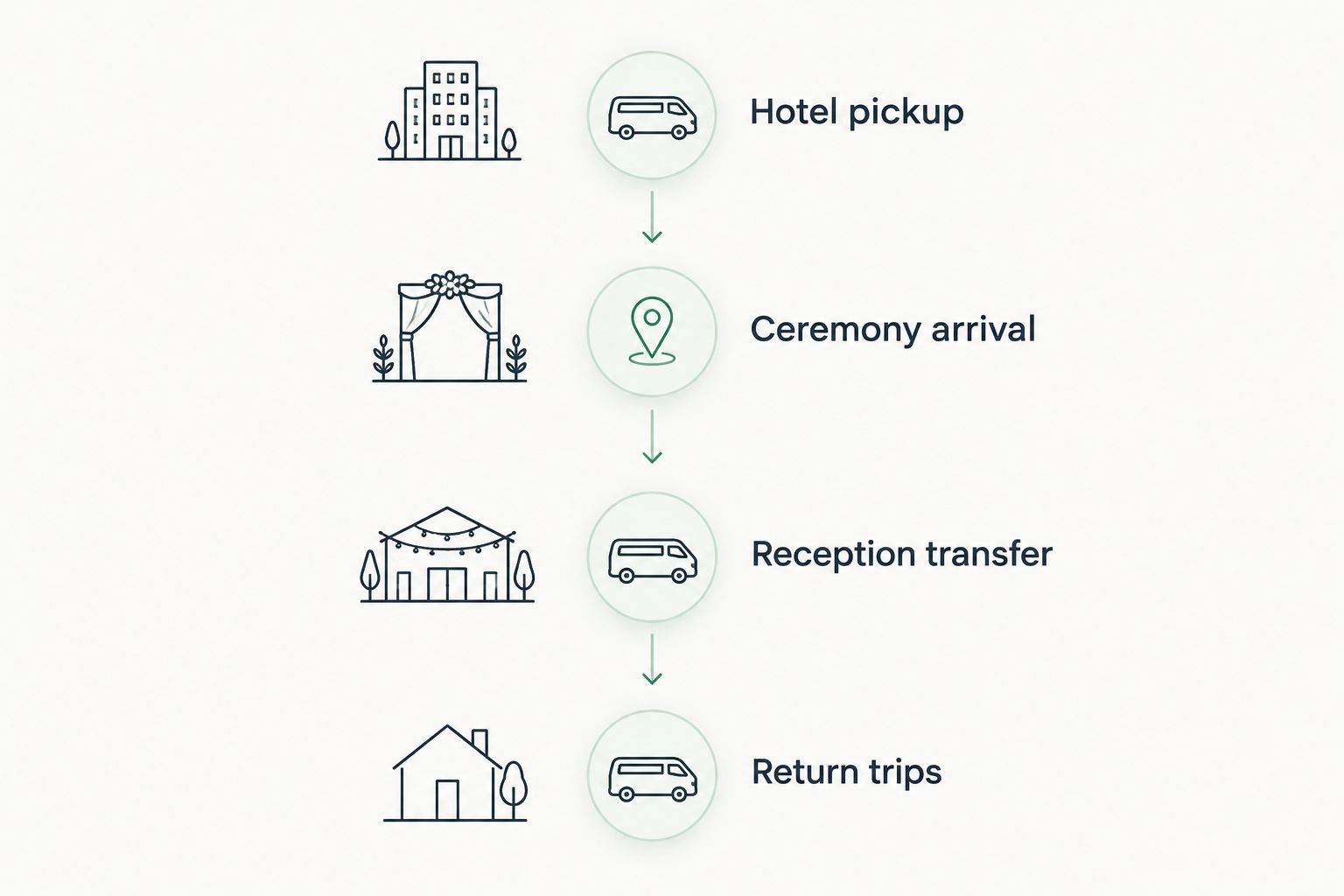
A route worksheet is only a starting point. Ask the venue and provider to review the plan together when loading access or vehicle movement needs clarification.
- Hotel pickup: identify the gathering point and the person checking passengers.
- Ceremony arrival: confirm the unloading location and route to the entrance.
- Reception transfer: account for guests who leave the ceremony independently.
- Return trips: publish departure instructions separately from outbound details.
- Record who can authorize a delay or revised destination.
5. Verify loading access with every venue
Contact each venue directly before treating an address as a confirmed pickup location. The main entrance, event entrance, and permitted vehicle loading area are not necessarily interchangeable. Ask where the assigned vehicle should approach and where it can wait between movements.
For your 2026 venue walkthrough, inspect the guest journey on foot. Follow the route from the gathering area to the vehicle and from the unloading point to the event entrance. This reveals instructions that a street address cannot communicate.
Best for access planning: venue-approved directions shared with both the provider and guest coordinator. A clear location reduces ambiguity, but it still needs a plan for changes on the day.
- Confirm the approved approach and loading location.
- Ask about gates, clearances, turning space, and waiting restrictions.
- Check the walking surface between the entrance and boarding point.
- Identify a sheltered gathering location if weather affects boarding.
- Agree on an alternate pickup point and who can activate it.
6. Assign communications without involving the couple
Create a short contact sheet and keep it separate from the full planning file. Designate 2 operational contacts: a primary transportation lead and a backup. Give the provider the approved contact chain, and establish how the venue coordinator reaches the same people.
Guest instructions should answer where to stand, when to be ready, and whom to contact. Keep operational discussions out of a large guest chat; route changes need an accountable decision-maker, not competing replies.
A staffed passenger check is especially useful when boarding a defined group. Its limitation is staffing: the person checking names cannot simultaneously remain inside the ceremony venue handling another assignment.
- Name the primary transportation lead and backup.
- Confirm the provider’s event-day contact procedure.
- Send guests a concise pickup message for their assigned journey.
- Define the process for an absent or late passenger.
- Remove the couple from routine transportation decisions.
7. Reconcile the final itinerary and close the return loop
Before the event, compare the latest manifest, venue instructions, and provider confirmation side by side. Use a document marked Final 2026 Transportation Plan, with a revision date and a named owner. Archive superseded copies so an earlier departure time does not remain in circulation.
Review the return journey with the same care as the ceremony transfer. Guests need to know which departure serves them, where to board, and what happens if they decide to leave independently. Do not assume the outbound passenger list remains accurate after the reception.
Best for final handoff: one approved itinerary acknowledged by every operational lead. A shared document is useful only when everyone knows which version controls the day.
- Reconcile passenger assignments against the latest confirmations.
- Confirm that every stop appears in the provider’s written scope.
- Obtain acknowledgment from the venue and transportation leads.
- Identify who checks return-trip boarding.
- Record a process for independent departures and last-minute changes.
Compare wedding transportation options
Choose by passenger grouping and operating responsibilities rather than appearance alone. The options below describe service models, not guaranteed features of a particular vehicle or provider. Request confirmation before assigning passengers.
| Option | Best for | Planning advantage | Key limitation |
|---|---|---|---|
| Chauffeur-driven Sprinter van | A defined group traveling on a shared itinerary | Assigns driving separately from wedding coordination | Seating, storage, and access require vehicle-specific confirmation |
| Chauffeur-driven sedan or SUV | Separate transfers for the couple or smaller parties | Keeps selected passengers on an independent schedule | Additional vehicles create separate arrivals to coordinate |
| Chauffeur-driven limousine | A wedding party prioritizing a limousine format | Provides a distinct vehicle choice for a dedicated transfer | The configuration still needs checking against clothing, belongings, and boarding needs |
| Self-drive passenger van | Groups with a designated driver outside the wedding’s operational roles | Places route and departure control with the designated driver | You must assign driving, parking, and vehicle-return responsibilities |
| Larger group shuttle or coach | Guest movements that exceed the confirmed Sprinter layout | Offers another format to assess for consolidated transport | Venue access and loading arrangements need separate review |
Blacklimoboston’s chauffeur-driven Sprinter service fits a shared-group itinerary, but it does not remove the planner’s responsibility for passenger assignments and venue coordination. If your manifest exceeds the confirmed layout, compare additional vehicles with a larger-format service rather than assuming repeated loops will meet the ceremony deadline.
Discuss your wedding transportation plan
Share your passenger groups, venues, and itinerary to discuss chauffeur-driven transportation.
Common mistakes wedding planners make
Choosing a vehicle before separating passenger movements
The wedding party and hotel guests can have different arrival requirements. Build the groups first. A combined headcount does not tell you whether everyone can travel together without disrupting photographs, preparation, or ceremony duties.
Treating boarding time as driving time
A route estimate does not include gathering passengers, checking names, or loading belongings. Keep boarding and travel as separate schedule entries, then review each with the people responsible for executing it.
Assuming the same vehicle suits every transfer
A hotel-to-ceremony journey and an airport pickup place different demands on storage and coordination. Check the complete assignment before deciding that a vehicle suitable for seated guests also suits arriving travelers with luggage.
Publishing pickup instructions before venue approval
An elegant invitation insert cannot correct an unusable loading point. Confirm access first, then publish the location in guest communications. If the venue changes it, update every active instruction rather than relying on verbal corrections.
Leaving reception departures undefined
A successful ceremony arrival does not complete the transportation plan. Assign return-trip responsibility and explain how guests communicate independent departures. Otherwise, your coordinator is left reconciling an outdated manifest at the end of the event.
FAQ
What is Sprinter van rental for wedding planners?
Sprinter van rental for wedding planners is group transportation arranged around wedding-related passenger movements. Confirm whether the arrangement includes a chauffeur or requires a designated driver, then match the vehicle to the itinerary.
Is a chauffeur-driven Sprinter better than a self-drive van for a wedding?
A chauffeur-driven Sprinter is the better fit when you want driving assigned separately from wedding coordination. A self-drive van requires you to allocate driving, parking, and vehicle-return responsibilities.
How many wedding guests fit in a Sprinter van?
Use the confirmed passenger seating of the assigned vehicle, not a generic Sprinter capacity. Ask the provider to confirm that the passengers and their belongings fit the proposed configuration together.
Can a wedding Sprinter carry luggage and garment bags?
Confirm luggage and garment-bag storage for the assigned vehicle before booking. Seating capacity alone does not establish storage space, so describe the belongings traveling on each transfer.
What should I send a wedding transportation provider?
Send passenger counts by journey, venue addresses, required arrivals, boarding needs, and a named operational contact. Include every planned stop and ask the provider to confirm the complete itinerary in writing.
Can wedding guests use the same Sprinter for ceremony and reception transfers?
Plan shared use only after confirming that the vehicle schedule covers every required movement. Check travel, boarding, unloading, and repositioning before relying on repeated trips.
Does Blacklimoboston provide chauffeur-driven Sprinter transportation?
Blacklimoboston provides chauffeur-driven Sprinter transportation throughout Boston and New England. Confirm the proposed vehicle configuration and arrangements for your wedding itinerary directly with the provider.
One last thing
The most useful transportation detail is often not the departure time; it is who confirms that the assigned passengers are aboard. Put that person’s name beside each journey in your 2026 itinerary. A schedule tells the vehicle when to move, while a named boarding lead turns the passenger list into an actionable departure decision.