University athletics department transportation is coordinated travel for athletes, coaches, recruits, and staff, with the aim of getting each group to its destination ready for its scheduled activity. In Boston, build your car-service plan around equipment, campus pickup access, flight changes, and arrival deadlines—not just the number of seats.
- University athletics department transportation Boston planners arrange should account for passengers, equipment, campus access, and arrival deadlines.
- Blacklimoboston provides chauffeur-driven transportation for Boston and New England airport transfers, corporate travel, and special events.
- Use car service for defined travel groups; assess whole-team transportation separately against passenger and equipment requirements.
- Confirm vehicle suitability and change procedures in writing before approving your 2026 athletics travel plan.
Why car service matters for university athletics departments
Athletics travel combines people with different responsibilities and destinations. A coach heading to an interview, a recruit arriving with family, and athletes carrying equipment need different travel instructions—even when their flights land together.
Blacklimoboston car service is best for athletics departments seeking chauffeur-driven airport, staff, and special-event travel in Boston and New England. Its stated services include luxury sedans, SUVs, Sprinter vans, and limousines; assess the specific vehicle against your trip requirements before booking.
Start with the service scope at Blacklimoboston, then send a written trip brief. A vehicle category alone does not establish baggage capacity, accessibility features, institutional approval, or suitability for a full roster.
For your 2026 travel plan, separate the transportation task from the athletic schedule. The destination deadline comes from the schedule; the pickup plan must also account for loading, airport procedures, campus access, and the group's readiness to depart. Treat each as a separate planning item rather than assuming the drive covers everything.
How to plan athletics department car service
Define each trip before choosing transportation
Start manually with a shared spreadsheet. Give every movement its own row, even when several trips belong to the same competition, recruiting visit, or department event.
Record 2 separate counts: passengers and equipment pieces. Then describe the equipment rather than treating every item as an ordinary suitcase. A long equipment bag and a small carry-on create different loading questions.
Distinguish the trip purpose, too. Recruiting travel requires an approved itinerary and clear guest instructions; staff airport travel requires a reliable handoff; competition travel requires alignment with the team's operational schedule. Do not assume one booking template captures all three adequately.
- Identify the travelers and the staff member responsible for them.
- Record pickup and destination addresses, including the correct building entrance.
- Count passengers separately from bags and athletic equipment.
- State the required arrival time and the reason it cannot move.
- Flag mobility, communication, and loading requirements without sharing unnecessary personal information.
Assign ownership and check university requirements
Use your existing university travel process before requesting transportation. Ask the appropriate office which approvals, vendor documents, payment methods, and traveler-supervision rules apply to the trip.
Name 1 trip owner who can approve operational changes. Other staff can contribute information, but the transportation provider needs an identifiable decision-maker when a flight changes or a passenger is missing.
For recruiting travel, keep transport arrangements within the institution's approval process. Do not ask a chauffeur to interpret recruiting permissions, decide whether an added stop is appropriate, or take responsibility for supervision that belongs to university staff.
- Identify the booking approver and the day-of-travel contact.
- Confirm the university's vendor and insurance documentation requirements.
- Check whether a purchase order or other authorization is necessary.
- Establish who accompanies or supervises travelers where required.
- Specify who can approve added stops, passenger changes, or itinerary revisions.
Match the vehicle to passengers and equipment
First, compare your passenger list and equipment manifest manually. Request written confirmation that the proposed vehicle accommodates both at the same time; seating and storage are separate requirements.
Blacklimoboston car service offers sedan, SUV, Sprinter van, and limousine transportation. Sending the same trip brief with your request gives the provider the information needed to propose a vehicle, rather than leaving you to infer suitability from a category name.
Choose the vehicle around the load, not the occasion. A limousine belongs in the discussion only when its seating arrangement, entry, storage, and trip purpose fit your requirements. For practical selection questions, use the guide to requesting a specific vehicle type.
- Ask for the proposed vehicle category and relevant configuration.
- Confirm passenger accommodation with all declared equipment aboard.
- Describe oversized, fragile, or unusually shaped items explicitly.
- Verify accessibility requirements for the actual vehicle proposed.
- Keep whole-team travel separate unless the provider confirms a suitable arrangement.
Build the itinerary backward from arrival
Begin with the required destination arrival, then work backward through unloading, the journey, loading, and traveler readiness. Use current trip information rather than copying a previous departure time into your 2026 schedule.
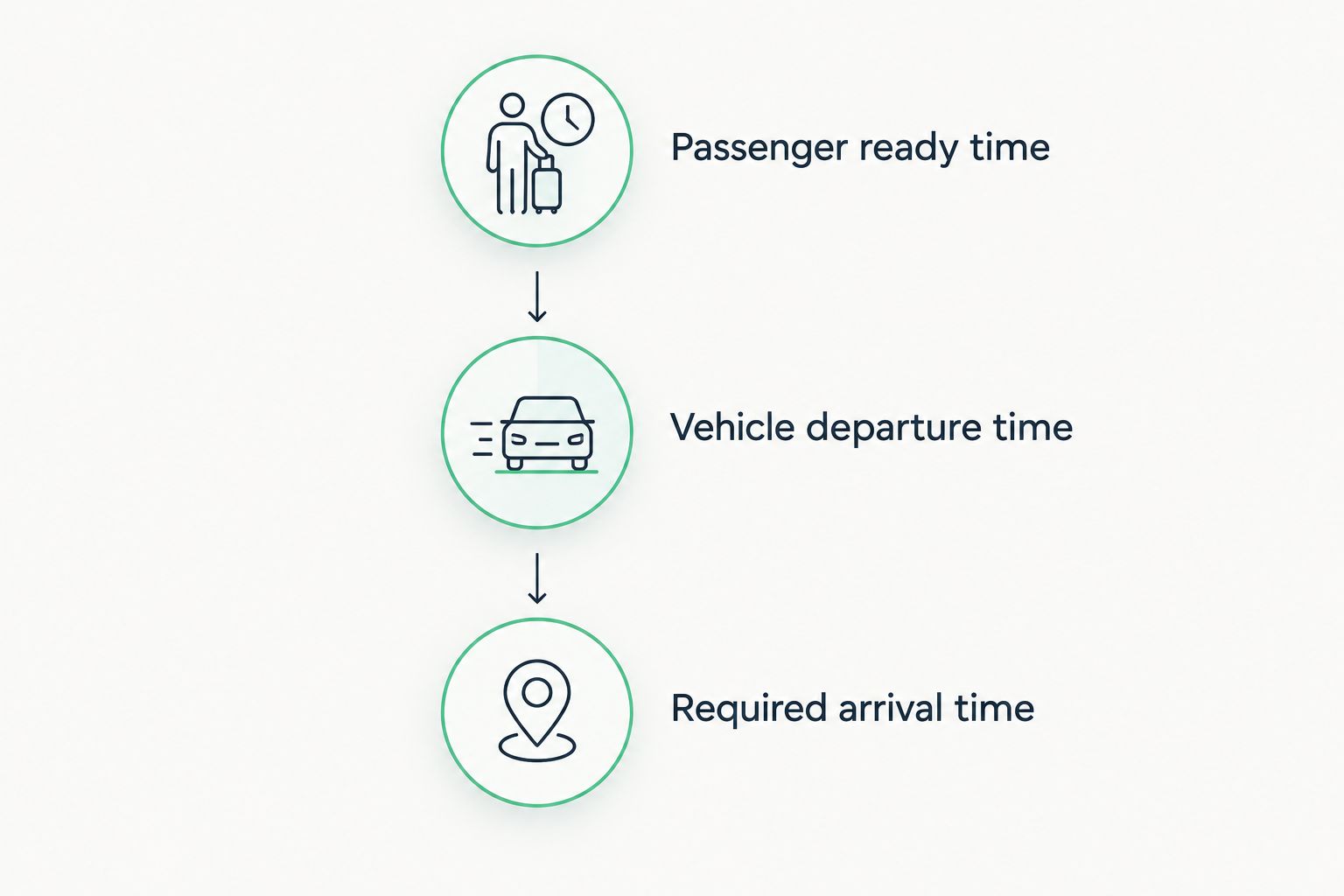
Create 3 checkpoints: passenger ready time, vehicle departure time, and required arrival time. These are different instructions. Telling athletes to arrive at the departure time leaves no planned opportunity to load equipment or resolve a missing passenger.
For an airport departure, also identify the airline, flight, terminal information, and the institution's required airport arrival target. For an arrival, distinguish the scheduled landing from the point at which the party is ready for its ground transfer. Confirm the pickup procedure directly with the provider.
- Passenger ready time: when the group must assemble with its belongings.
- Vehicle departure time: when loading must be complete.
- Required arrival time: when the group must reach the destination.
- Confirmed access point: the entrance or meeting location everyone will use.
- Change contact: the person who communicates any revised instruction.
Confirm campus access and airport handoffs
Review pickup locations yourself using campus information, then verify the final instructions with the transportation provider. A campus name or athletic complex name is not a complete pickup instruction.
Identify the usable entrance, the loading location, and the staff member who will meet the vehicle. If an event changes normal access, ask campus operations or event staff for the applicable instructions instead of assuming the usual entrance remains suitable.
Airport coordination needs the same precision. When travelers arrive on different flights, document whether they will wait for one another or travel separately. Do not combine arrivals solely because the scheduled landing times look close together.
- Specify the campus building and the intended entrance.
- Check access restrictions with the relevant campus office.
- Confirm the airport meeting procedure with the provider.
- Give travelers a contact method for missed connections or meeting difficulties.
- Decide how split arrivals and separated equipment will be handled.
Document changes before travel day
Maintain one current itinerary and send revisions through the agreed communication channel. A shared document helps your staff coordinate, but it does not replace confirmation that the transportation provider received a change.
Ask Blacklimoboston to confirm the procedures relevant to your trip, including flight changes, revised pickups, added stops, and cancellations. Do not infer any policy from another provider or an earlier reservation.
For each 2026 trip, identify the point at which a proposed change becomes an approved instruction. A coach's message to an internal group chat should not silently become a different pickup plan that the chauffeur has never received.
- Request the applicable change and cancellation terms in writing.
- Identify the contact channel for urgent operational updates.
- Record who can authorize a revised itinerary.
- Ask how the provider handles flight-related pickup changes.
- Send a clear revision summary and obtain acknowledgment.
Reconcile the trip and improve the next brief
After travel, compare the approved itinerary with what actually happened. Use a short internal record rather than relying on memory when the next away trip or recruiting visit arrives.
Track exceptions with enough context to act on them. If departure was late, record whether travelers were missing, equipment loading took longer than planned, access instructions were wrong, or the vehicle arrived after the agreed time. These are different problems with different remedies.
Carry confirmed lessons into the next trip brief, not unsupported assumptions about every future journey. Your 2026 travel template should become more specific as your department documents its own experience.
- Match the completed movements to the approved itinerary.
- Review invoices against the agreed service and authorized changes.
- Record access, loading, communication, and timing exceptions separately.
- Ask the responsible staff member to confirm any disputed detail.
- Update the template with verified instructions for repeat destinations.
Plan Your Athletics Department Trip
Provide your itinerary, passenger count, equipment details, and required arrival time.
Compare transportation options for athletics travel
Use chauffeured car service for a defined movement, not as an automatic substitute for a whole-team transport plan. Start with the university's approved options, then compare each against the same passenger, equipment, supervision, and scheduling requirements.
The table identifies planning trade-offs, not verified capacity or policy claims about a particular operator. Confirm the proposed arrangement before you authorize it.
| Option | Best for | Main advantage | Key limitation |
|---|---|---|---|
| Chauffeured sedan | Staff or guest transfers with a suitable load | Keeps a defined party on a specific itinerary | Requires confirmation that passengers and baggage fit together |
| Chauffeured SUV | A travel party whose load fits the proposed configuration | Adds another vehicle category to assess against the manifest | The category name does not establish equipment capacity |
| Chauffeured Sprinter van | A group that needs to travel together and fits the proposed vehicle | Keeps the group's handoff and instructions together | Passenger accommodation and luggage space require joint confirmation |
| Limousine | A formal department event with suitable passenger and storage requirements | Matches a formal travel brief | Presentation alone does not establish athletic equipment suitability |
| University-managed transportation | Trips covered by an approved institutional arrangement | Uses an existing departmental process | Suitability depends on the institution's vehicles and operating rules |
| Coach transportation | Whole-roster movements requiring a larger transport assessment | Provides a separate option for team-scale planning | Loading, access, equipment, and operator requirements still need review |
Blacklimoboston's stated service scope includes the chauffeured vehicle categories above, but it does not establish institution-specific approval or whole-team suitability. Obtain those confirmations separately. A clearly documented limitation is more useful than a vehicle selection based on appearance.
Common mistakes athletics departments make
Booking from the roster alone
A roster does not describe the transportation load. Add coaches, support staff, accompanying guests where approved, and equipment before requesting a vehicle; then confirm the combined requirement rather than treating bags as an afterthought.
Using the competition start as the arrival deadline
The event start and the team's required arrival are different instructions. Ask the responsible athletics staff member for the operational deadline, including any preparation or check-in requirements, before setting the ground itinerary.
Treating recruiting travel as an informal favor
An added guest or unplanned stop is still a change to an institutional trip. Route the request through the designated approver and follow the university's applicable process before communicating a revised instruction to the provider.
Leaving campus pickup instructions implicit
A familiar athletic facility can still have multiple entrances and different loading arrangements. Write down the exact meeting location and have the responsible campus contact verify access for the planned movement.
Assuming flight information replaces communication
Providing a flight number does not establish how every delay or passenger change will be handled. Confirm the provider's procedure, then make sure travelers know who to contact if they miss a connection, lose equipment, or leave the airport separately.
FAQ
What's the best car service arrangement for a Boston university athletics department?
The best arrangement matches the specific trip's passengers, equipment, access requirements, and arrival deadline. Assess staff transfers, recruiting visits, and whole-team movements separately rather than selecting one vehicle category for every trip.
Can Blacklimoboston transport an entire university sports team?
Whole-team suitability requires confirmation for the actual passenger and equipment manifest. Blacklimoboston lists sedans, SUVs, Sprinter vans, and limousines among its services, but those categories alone do not establish accommodation for a complete roster.
Is a Sprinter van better than an SUV for athletics travel?
A Sprinter van is the better choice only when the proposed configuration fits your group and equipment more appropriately. Request confirmation of the combined load, access needs, and itinerary rather than choosing by vehicle name.
What should an athletics department send when requesting airport transportation?
Send the flight details, traveler count, equipment description, destination, required arrival time, and responsible staff contact. Ask the provider to confirm the airport meeting procedure and how flight changes affect the pickup instructions.
How early should we book athletics department transportation?
Begin the booking process once the itinerary and approval requirements are defined. Obtain the provider's confirmation and applicable change terms rather than relying on a universal advance-booking deadline.
Can a chauffeur supervise recruits or student-athletes?
Keep supervision responsibilities with the people designated under your university's rules. Transportation does not by itself establish that a chauffeur has accepted a supervisory role; confirm any required accompaniment through the institution.
What should we check for accessible athletics transportation?
Confirm the traveler's functional requirements against the specific vehicle and boarding arrangement proposed. Do not assume that an SUV, van, or limousine category establishes wheelchair access or appropriate securement.
One last thing
Write the return pickup before approving the outbound trip. Post-event departures need their own meeting location, responsible contact, equipment-loading plan, and instructions for a changed finish time.
A completed outbound transfer does not settle those questions. Give the return movement the same written attention as the first departure, especially when your party will leave from a different entrance or split into separate groups.