Yes—a Boston chauffeur service can accommodate wheelchair passengers when the assigned vehicle and assistance arrangements meet the passenger’s needs. Transporting a folded wheelchair is not the same as transporting someone seated in a wheelchair: confirm whether you will transfer to a vehicle seat or need an accessible vehicle with suitable boarding equipment, wheelchair securement and occupant restraints.
- Can a chauffeur service accommodate wheelchair passengers? Yes, when the assigned vehicle meets the passenger’s boarding and travel needs.
- Blacklimoboston provides Boston-area chauffeured transportation; confirm wheelchair requirements directly before booking.
- A wheelchair that fits in the luggage compartment does not establish that its user can board safely.
- Confirm the vehicle, assistance, pickup location and return journey in writing.
Why this matters
The wrong vehicle creates a problem before your journey begins. A spacious cabin does not establish wheelchair access, and a driver’s offer to help does not explain what assistance is included.
For a 2026 reservation, make access requirements part of the initial inquiry rather than a note added after confirmation. Use the contact page to describe how you need to board, how you will travel and what equipment must accompany you.
Can a Boston chauffeur service accommodate wheelchair passengers?
Yes, but the answer depends on the passenger’s travel position and the specific vehicle—not simply the description “chauffeur service.” Start by distinguishing these arrangements:
| Travel arrangement | Best for | What must be confirmed | Main limitation |
|---|---|---|---|
| Transfer to a vehicle seat | Passengers who choose and can safely complete a transfer | Seat access, transfer assistance and storage for the mobility device | The passenger must leave the wheelchair to travel |
| Remain seated in a wheelchair | Passengers who need or prefer to travel in their wheelchair | Accessible boarding, vehicle fit, wheelchair securement and occupant restraints | An ordinary sedan, SUV or passenger van does not establish suitability |
| Travel with a companion | Passengers who want a familiar person involved in the journey | Companion seating and clearly agreed assistance responsibilities | A companion does not replace accessible vehicle equipment |
Choose the travel arrangement first, then assess the vehicle. Starting with a preferred body style reverses that decision and risks overlooking the boarding requirement.
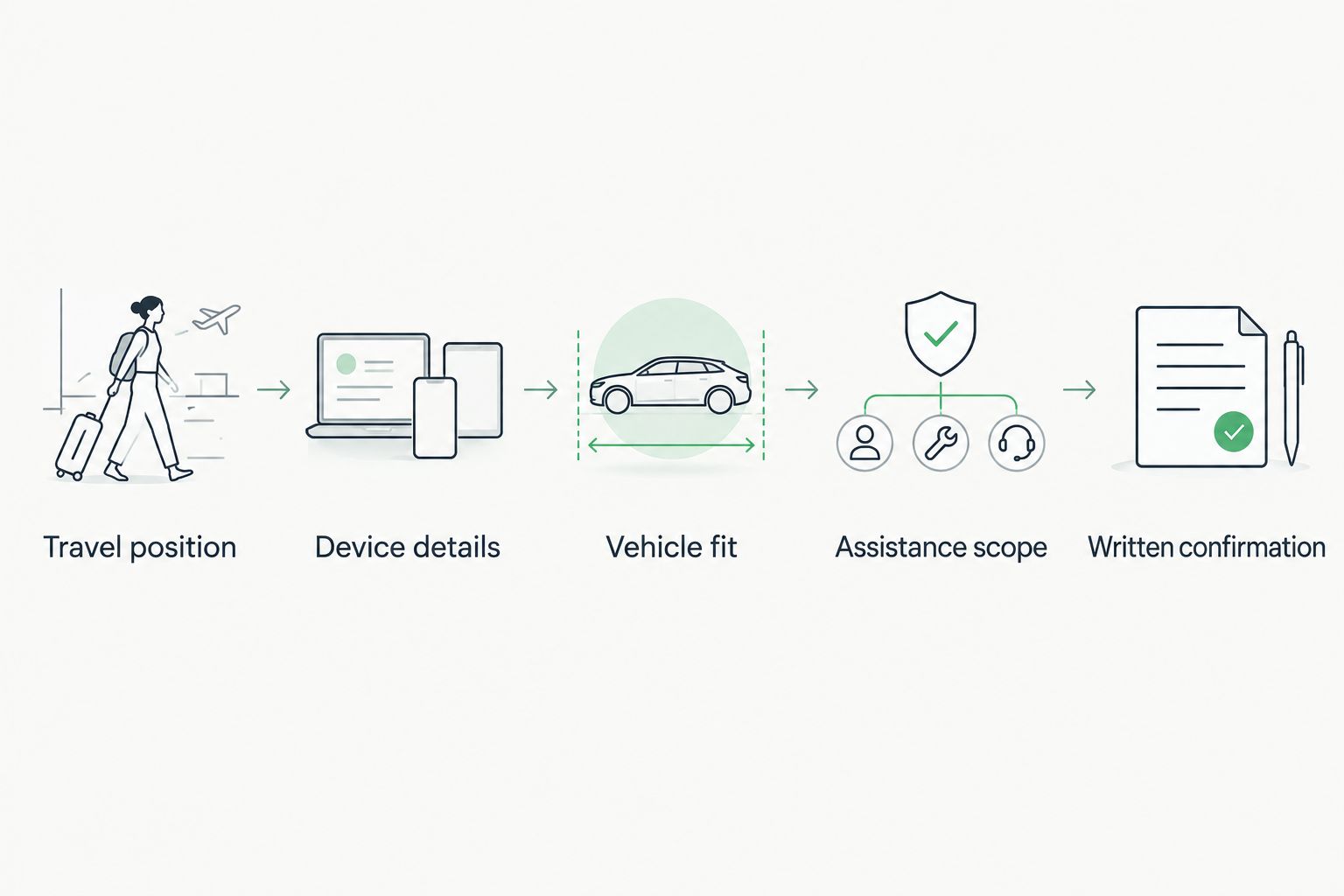
Confirm access before you confirm the ride
- Travel position: State whether you will transfer to a vehicle seat or remain in your wheelchair. Do not leave the dispatcher to infer this from the word “wheelchair.”
- Device details: Share the wheelchair or scooter type, relevant dimensions and any handling instructions. Explain whether it folds or requires specific storage arrangements.
- Vehicle fit: Ask which vehicle configuration will serve the trip and how its boarding equipment and interior space match your requirements.
- Assistance scope: Establish what the chauffeur will do, what your companion will do and whether you need additional assistance.
- Written confirmation: Request a record of the agreed vehicle requirements, pickup instructions and arrangements for the return journey.
This sequence gives the operator a usable transport request. It also gives you a clear basis for checking that the reservation matches what you actually need.
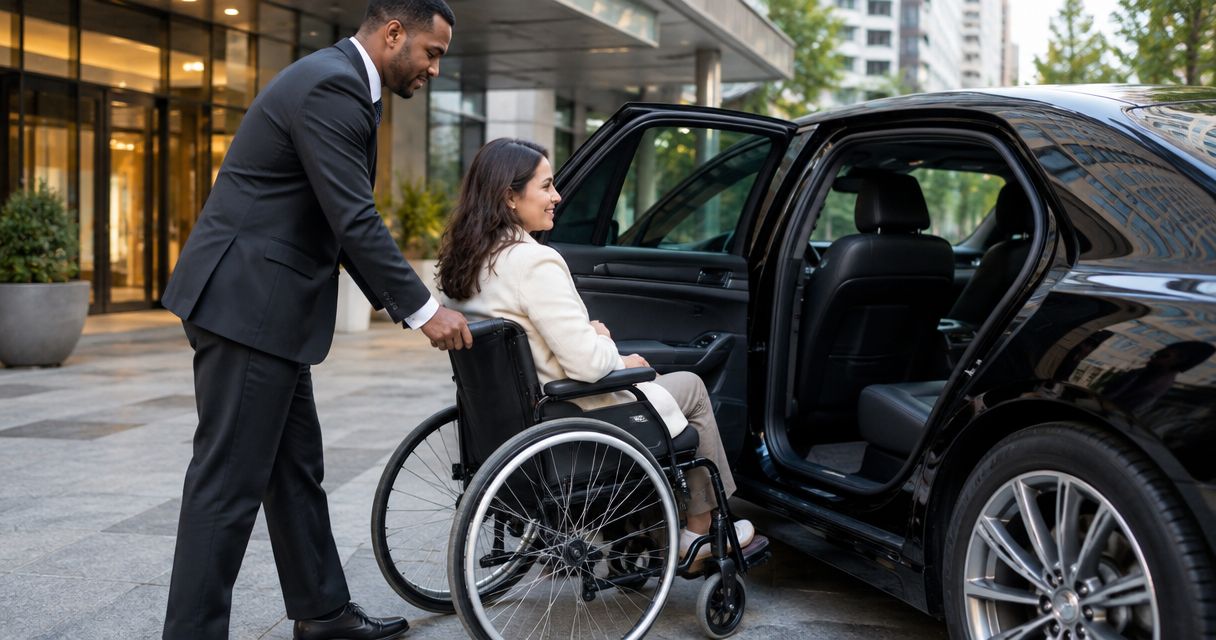
Transferring from a wheelchair to a vehicle seat
Best for passengers who choose and can safely complete the transfer, a conventional vehicle-seat arrangement separates passenger seating from wheelchair storage. That distinction matters: confirming storage does not confirm access to the seat.
Ask about the boarding position, doorway access and the space needed to approach the seat. Explain any transfer method you already use, but do not assume a chauffeur provides lifting or personal-care assistance.
A folding wheelchair still needs an agreed storage location. Specify whether it must remain upright, whether detachable components travel separately and who will handle it; use the device manufacturer’s instructions rather than improvising a loading method.
The advantage is that this arrangement can suit a passenger who does not require wheelchair-seated travel. The limitation is the transfer itself. If entering or leaving the vehicle does not work for you, luggage capacity does not solve the problem.
For a 2026 trip, include the transfer arrangement in the reservation record. Repeat it when confirming the return pickup, especially if another vehicle or chauffeur will handle that journey.
Remaining seated in a wheelchair during travel
Best for passengers who need to remain in their wheelchair, wheelchair-seated travel requires a vehicle configured for that purpose. Ask about accessible boarding, the usable interior space and the equipment used to secure both the wheelchair and its occupant.
Wheelchair securement and occupant restraints serve different purposes. Securing the wheelchair does not, by itself, establish that the passenger has an appropriate restraint arrangement.
Do not treat a Sprinter van, limousine or large SUV as accessible simply because it has more cabin space. Vehicle names describe a category, not the boarding equipment or wheelchair travel position installed in a particular vehicle.
The benefit of a suitable configuration is that the passenger does not have to transfer into a conventional seat. The limitation is specificity: the actual vehicle, wheelchair and boarding arrangement must work together.
Request confirmation of the configuration, not a general assurance that the vehicle is “large enough.” If the proposed vehicle changes, ask the operator to reconfirm the access requirements before accepting the substitution.
Why wheelchair accommodation varies
Wheelchair accommodation varies because the transport request involves more than passenger count. These factors determine what you need the operator to confirm:
- Travel position: Transferring to a seat and remaining in a wheelchair require different vehicle arrangements.
- Mobility device: Folding, rigid-frame and powered devices have different handling and storage requirements. Supply details for your actual device.
- Boarding equipment: A ramp or lift must suit the passenger, device and vehicle configuration; its presence alone is not a complete suitability check.
- Assistance required: Opening a door, handling luggage, assisting a transfer and providing personal care are different tasks. Agree on responsibilities explicitly.
- Pickup environment: Steps, curb access, pavement conditions and space beside the vehicle affect where boarding can take place.
- Journey changes: An additional stop, a different return location or a replacement vehicle introduces details that need confirmation.
Avoid compressing these requirements into “wheelchair-friendly.” Give the operator a practical description of the trip instead. A specific request is easier to assess and harder to misunderstand.
How should you arrange an accessible Logan Airport pickup?
For Logan Airport travel, confirm the meeting location and boarding arrangement separately from the flight details. A flight number tells the operator when you arrive; it does not explain how you will reach or enter the vehicle.
Describe where you expect airport assistance to end and where the chauffeur’s agreed assistance begins. If you need help between the terminal and the vehicle, establish who is responsible before departure.
Your pickup instructions should address:
- The agreed meeting point and how you will identify it.
- How you will communicate if your arrival location changes.
- Where the vehicle can position for your boarding arrangement.
- How your wheelchair, luggage and companion will travel together.
- What happens if the assigned vehicle cannot use the planned location.
For a 2026 airport reservation, keep those instructions alongside your flight information. The guide to whether a private chauffeur is worth it for Boston airport transfers covers the broader transport decision; vehicle access remains a separate confirmation.
Can Blacklimoboston accommodate a wheelchair passenger?
Blacklimoboston provides chauffeur-driven sedans, SUVs, Sprinter vans and limousines for airport transfers, corporate travel, events and leisure trips throughout Boston and New England. Those service categories do not establish which wheelchair arrangements a particular vehicle supports.
Blacklimoboston is a fit for Boston-area chauffeured travel only when the assigned vehicle meets the passenger’s access needs. Ask directly whether the proposed trip involves wheelchair storage after a transfer or travel while seated in the wheelchair.
The relevant benefit is a chauffeured service covering the stated journey types and region. The limitation is that a general fleet description does not confirm accessible boarding equipment, wheelchair securement or transfer assistance.
Before proceeding, request an answer tied to your actual requirements. A reservation should record the agreed arrangement rather than rely on a broad description of the fleet.
Discuss Your Wheelchair Travel Requirements
Explain your boarding method, mobility device and assistance needs before confirming the journey.
What should you send when requesting a ride?
Send a short, practical access brief with your itinerary. You do not need to substitute a diagnosis for a description of the boarding and travel arrangements you require.
For your 2026 inquiry, include:
- Journey details: Date, pickup point, destination, stops and return arrangements.
- Travel position: Whether you will transfer or remain seated in the wheelchair.
- Device information: Type, relevant measurements, folding method and handling instructions.
- Other travelers: Companions and the seating they require.
- Luggage: Bags and equipment that need to travel with you.
- Assistance: Tasks you need the chauffeur to perform and tasks handled by someone else.
- Location details: Steps, entrance restrictions or other known boarding obstacles.
Ask the operator to respond against those requirements. A reply that merely confirms the date and vehicle category leaves the central access question unanswered.
What should you check before the return journey?
Confirm the return journey as its own boarding event. The destination entrance, pickup space and assigned vehicle can differ from the outbound arrangement.
Before a 2026 event or appointment, record the return meeting point and a way to communicate changes. Explain whether a companion will still be present and whether the same assistance is required.
If a vehicle substitution becomes necessary, ask for renewed confirmation of boarding, seating and equipment compatibility. An alternative vehicle is suitable only when it meets the same access requirements—not merely when it carries the same passenger count.
FAQ
Can I stay in my wheelchair during a chauffeur ride?
Yes, when the assigned vehicle supports wheelchair-seated travel with suitable boarding equipment, wheelchair securement and occupant restraints. Confirm the configuration for your actual wheelchair before booking.
Can a standard chauffeur car carry a folding wheelchair?
A standard chauffeur car can carry a folding wheelchair when its storage space and handling arrangements suit the device. That does not confirm that the passenger can safely transfer into the vehicle seat.
Is a Sprinter van automatically wheelchair accessible?
No, a Sprinter van is not automatically wheelchair accessible. Confirm the specific vehicle’s boarding equipment, interior configuration and wheelchair travel arrangements rather than relying on the vehicle name.
Will the chauffeur lift me into the vehicle?
Do not assume that a chauffeur will lift you into the vehicle. Describe the assistance you require and obtain explicit agreement on responsibilities before confirming the trip.
Can my companion travel with me in an accessible vehicle?
Your companion can travel with you when the confirmed vehicle configuration includes suitable seating for the full party. Ask the operator to account for the wheelchair travel position, companions and luggage together.
Does Blacklimoboston provide wheelchair-accessible transportation?
Blacklimoboston’s stated services include chauffeured sedans, SUVs, Sprinter vans and limousines, but those categories do not confirm wheelchair accessibility. Request trip-specific confirmation of boarding equipment, travel position and assistance.
What should I do if the chauffeur vehicle changes?
Ask the operator to reconfirm every access requirement for the replacement vehicle. Do not treat a similar vehicle category as proof of equivalent boarding or wheelchair accommodation.
One last thing
Confirm the drop-off entrance, not just the street address. A vehicle can reach the correct building while leaving you at an entrance that does not match your access needs.
Ask your destination which entrance you should use, then give that information to the operator. Carry the same detail into the return instructions so the journey ends—and starts again—at the right place.