

Instead of manually reconciling every flight change and texting each traveler separately, use a shared arrival manifest to turn multiple Boston-bound flights into confirmed pickup groups. This 2026 workflow connects traveler details, flight status, vehicle requirements and pickup instructions without treating landing time as the time passengers are ready to leave.
- For group airport pickup service multiple flights boston, build one manifest before assigning vehicles.
- Blacklimoboston suits Boston groups seeking chauffeur-driven airport transfers; confirm the coordination arrangements before booking.
- Group passengers by readiness, destination and luggage requirements—not scheduled landing time alone.
- Require acknowledgment whenever a flight change affects a confirmed pickup.
Why this matters
A flight itinerary describes aircraft movements. An airport pickup plan must describe where passengers will meet, when they will be ready and which vehicle assignment has been confirmed. Those are different records.
Blacklimoboston is best for Boston groups seeking chauffeur-driven airport transfers. Its stated services include luxury sedans, SUVs, Sprinter vans and limousines throughout Boston and New England. Start with Blacklimoboston to discuss transportation requirements, then confirm how the provider will handle your arrival manifest and changes.
The workflow below is a coordination method, not a software integration or a claim about a provider's booking system. Its advantage is a clear handoff between planner, transportation provider and traveler; its limitation is that someone must maintain the record and obtain confirmations.
Before you start
- Collect the source material: current itineraries, operating flight numbers, arrival dates, destination addresses, traveler contact details and luggage requirements. Obtain permission before sharing personal travel information.
- Assign access and ownership: choose a shared spreadsheet or equivalent record, name a primary coordinator and backup, and agree with the transportation provider on the channel for changes. Restrict traveler access to the information each person needs.
- Resolve the hidden timing issue: a ticket can show a connecting flight or codeshare number rather than the operating flight arriving in Boston. Record the final arriving segment, Boston-local arrival date and whether passengers must complete immigration or collect checked bags before meeting the chauffeur.
Do not build a shared departure around an unconfirmed passenger-ready time. First establish how the provider wants travelers to report readiness and where each pickup will occur.
Traveler manifest
Create the working record before requesting vehicle assignments. The bold labels below are suggested spreadsheet column names, not claims about fields in a booking interface.
- Create a Travelers sheet with Traveler name, Mobile contact, Flight reference, Destination, Luggage, Accessibility requirements and Pickup group. Use 1 row per traveler so a change does not disappear inside a group note.
- Create a Flights sheet with Flight reference, Operating airline, Operating flight number, Arrival airport, Arrival date, Scheduled arrival, Updated arrival, Terminal, Arrival process and Last checked. Use 1 row per arriving flight segment.
- Enter dates and times consistently. Label arrival times Boston local time rather than leaving the time zone implicit, especially when an itinerary crosses midnight.
- Connect each traveler to the correct flight reference. Keep ticket confirmation codes and other unnecessary booking credentials out of the shared manifest.
- Create a Pickup groups sheet with Group reference, Assigned travelers, Destination, Readiness status, Vehicle requirement, Meeting instructions, Provider confirmation and Change status. Use 1 row per planned departure.
Expected result: every traveler has a flight reference, a destination and a place in the pickup plan. Every flight appears once in the flight record, even when several travelers share it.
For your 2026 arrival manifest, keep a dated working version rather than circulating competing attachments. If a traveler sends a correction privately, enter it into the shared record before treating it as an operational instruction.
Pickup group assignments
Assign passengers according to the journey they can actually take together. Similar landing times alone do not establish that passengers will be ready at the same time.
- Sort travelers by Destination, then review Updated arrival, Arrival process and Luggage. Identify passengers whose readiness and destination make a shared departure practical.
- Choose a departure pattern from the table below. Ask travelers whether waiting for other arrivals is acceptable rather than assuming everyone wants the same arrangement.
- Describe the complete vehicle requirement: passenger list, luggage, accessibility needs and any requested child-restraint arrangements. Ask the provider to confirm suitability; do not infer capacity from the vehicle category alone.
- Enter the proposed arrangement in Pickup group and Vehicle requirement. Keep Provider confirmation unconfirmed until the transportation provider explicitly accepts the assignment.
- Record what will happen if a traveler is delayed: hold the group, split the departure or request a separate arrangement. Confirm any change with the provider before notifying travelers that it is settled.
| Departure pattern | Best for | Advantage | Limitation |
|---|---|---|---|
| Separate flight pickups | Travelers with different arrival processes or schedules | Keeps each flight's passengers independent | Creates more assignments to coordinate |
| Shared departure | Travelers with compatible readiness and the same destination | Keeps the group together for the onward journey | Earlier passengers must agree to wait |
| Hybrid departures | Mixed arrivals with some compatible groups | Combines suitable passengers without holding everyone | Requires clear group references and change ownership |
These are planning options, not promises about service arrangements. Choose the departure pattern before requesting a specific vehicle. Blacklimoboston airport transfers include several vehicle categories, but the passenger-and-luggage combination still needs confirmation.
Expected result: every pickup group has named passengers, a destination, a proposed departure pattern and an agreed delay response. No passenger belongs to competing active assignments.
Provider handoff and traveler instructions
A manifest becomes an executable plan only when the people responsible for the ride accept it. Keep provider confirmation separate from traveler communication.
- Send the transportation provider the current manifest through the agreed channel. Identify the coordinator, backup contact and version date, and request confirmation of each pickup group.
- Ask the provider to confirm the vehicle assignment, meeting procedure, relevant contact method and process for flight changes. Ask how waiting, cancellations and itinerary changes are handled rather than assuming a policy.
- Enter the accepted instructions under Meeting instructions and record the acknowledgment under Provider confirmation. Resolve unclear meeting locations before sending traveler instructions.
- Send each traveler only the relevant pickup group, destination, meeting instructions and contact route. Explain how to report that the group has cleared its arrival formalities and is ready.
- Mark Change status as confirmed only after the current assignment is accepted. If an instruction changes, replace the outdated traveler message with an explicitly identified revision.
Expected result: the provider and travelers have matching instructions. The coordinator can identify which assignments are confirmed without searching through separate message threads.
For the 2026 handoff, distinguish the readiness signal from the meeting location. A message saying that passengers have collected their bags does not establish where the vehicle will meet them. Use the provider's current, specific instructions rather than a generic airport meeting point.
Discuss your group airport transfers
Share flight details, destinations and luggage requirements to confirm a coordinated transportation plan.
Arrival-day change control
Keep flight information, passenger readiness and provider acceptance separate throughout arrival day. Updating one does not automatically update the others.
- Review Updated arrival and Terminal using current flight information. Add the review time under Last checked so stale information is visible.
- Ask the designated traveler contact to report the group's actual progress. Record Readiness status as awaiting arrival, completing arrival formalities, ready to meet or departed, as appropriate.
- Compare the change with the confirmed pickup group. Check whether it affects the meeting instructions, shared departure or vehicle requirement.
- Send affected changes to the provider and request acknowledgment. Keep Change status pending until the revised plan is accepted.
- Send revised traveler instructions after provider confirmation, then record departure. Close the assignment only when the group has left with the correct transportation.
Expected result: the record distinguishes an observed flight change from an accepted pickup change. Travelers receive instructions that match the confirmed arrangement.
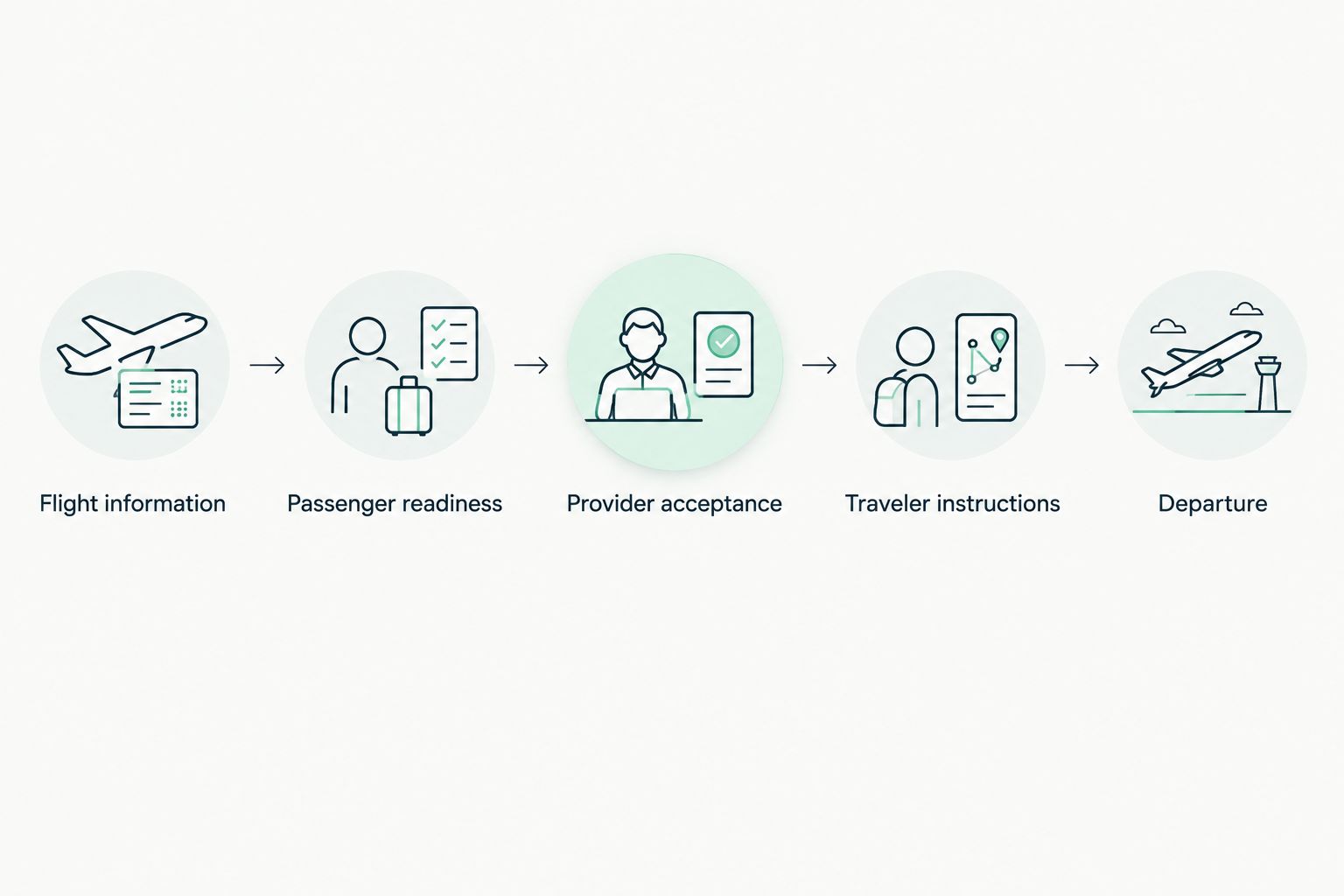
Treat the diagram as a handoff sequence, not an automatic connection between systems. Each transition needs an owner who checks that the next action has happened.
Variant: revise pickups whenever a flight changes
Use the same manifest when delays or cancellations disrupt a shared departure. The additional work is deciding whether the original grouping still makes sense—not simply replacing the arrival time.
For a 2026 change protocol, define the decision owner before travel day:
- Timing change: update the flight record, assess the effect on readiness and ask the provider whether the confirmed arrangement needs revision.
- Cancellation or rebooking: retain the original entry as superseded, enter the replacement arriving segment and reconnect the affected travelers to it.
- Group split: confirm the revised passenger lists and vehicle arrangements before issuing separate instructions.
- Destination change: update the affected travelers and pickup group, then obtain acceptance of the revised journey.
A flight alert is useful input, but it is not proof that a chauffeur assignment has changed. Require acknowledgment for every operational revision. Do not describe your workflow as automatic unless the provider has explicitly confirmed the relevant connection and its responsibilities.
Troubleshooting
The flight number points to the wrong arrival
Check the operating airline, final arriving segment and Boston-local date. A codeshare label or an earlier connection can lead the coordinator to monitor the wrong flight. Correct the flight reference for every affected traveler.
The flight has landed, but passengers are not ready
Keep the flight status separate from Readiness status. Ask the traveler contact whether the group is collecting bags or completing arrival formalities, then notify the provider through the agreed channel. Do not send passengers toward a meeting point based on landing alone.
A delayed traveler holds up the shared departure
Apply the agreed delay response rather than making an improvised promise. Confirm whether the group will wait or split, obtain provider acceptance and send each affected traveler the revised instructions.
The vehicle requirement no longer matches the group
Recount passengers and review luggage or accessibility changes against the confirmed assignment. Ask the provider to reconfirm suitability before departure. A familiar vehicle-category name does not settle whether the revised group fits.
Travelers receive conflicting instructions
Identify the current confirmed version and explicitly withdraw the older message. Route further revisions through the designated coordinator, and ask the traveler contact to acknowledge the replacement instructions.
Customize your workflow
For a corporate arrival, add the meeting start time as a planning constraint, not a guaranteed arrival outcome. For a wedding or leisure group, add the host contact and onward destination so travelers know who is responsible after the airport transfer.
Keep sensitive information out of broadly shared views. A traveler needs the relevant pickup instructions, not another passenger's complete itinerary or personal requirements.
Use the guide to adjusting pickups when flights are delayed to develop the change-handling side of the plan. Confirm any provider-specific arrangements directly before relying on them.
FAQ
How do I arrange airport pickups for a group arriving on multiple flights in Boston?
Build a shared manifest linking each traveler to an arriving flight, destination and pickup group. Confirm vehicle requirements and meeting instructions with the transportation provider before sending the final plan to travelers.
Should everyone wait for the last flight to land?
Use a shared departure only when travelers accept the wait and their readiness and destinations are compatible. Separate or hybrid departures keep unrelated delays from holding the entire group.
Can Blacklimoboston provide transportation for an airport group?
Blacklimoboston provides chauffeur-driven airport transfers using luxury sedans, SUVs, Sprinter vans and limousines. Confirm the vehicle arrangement, luggage requirements and multiple-flight coordination process directly before booking.
What flight details does the pickup coordinator need?
Record the operating airline, operating flight number, final arrival airport, Boston-local arrival date and current arrival time. Connect those details to traveler contacts, destinations and arrival-process requirements.
Does a flight delay automatically change my chauffeur pickup?
Do not assume a flight delay automatically changes a confirmed chauffeur assignment. Send the operational change through the agreed channel and obtain acknowledgment before issuing revised traveler instructions.
How do I choose a vehicle for passengers with luggage?
Give the provider the passenger list, luggage details and accessibility requirements, then request confirmation of a suitable vehicle. Do not choose solely from a vehicle-category name or passenger count.
What is the most important part of a multiple-flight pickup plan?
The most important control is a confirmed handoff between coordinator, provider and travelers. Keep flight status, passenger readiness and accepted pickup instructions separate so an information update is not mistaken for a confirmed booking change.
One last thing
The last flight to land is not necessarily the last group to be ready. For your 2026 pickup plan, organize departures around confirmed passenger readiness, not the order of aircraft arrivals. That distinction keeps a tidy itinerary from becoming a misleading pickup schedule.