

Book corporate car service as soon as your travel date, route, and passenger requirements are firm enough to submit a reservation. There is no single booking interval that fits an individual airport transfer, a multi-stop executive itinerary, and a group event; confirm the provider’s reservation and change terms before treating transportation as settled.
- How far in advance should corporate car service be booked? Begin when your date, route, and passenger requirements are set.
- For Boston corporate travel, distinguish a submitted request from an explicitly confirmed reservation.
- Group transportation needs an agreed passenger plan, luggage requirements, and pickup instructions before final confirmation.
- Blacklimoboston provides corporate car service for business travel throughout Boston and New England.
How far in advance should corporate car service be booked?
Use itinerary readiness—not an unsupported day count—as your booking trigger. Start the reservation process once you can state where passengers need to be, when they need to arrive, and what transportation they require.
For a 2026 business trip, submit those details through the booking page. Identify anything still provisional rather than presenting an unfinished itinerary as final.
The table below compares booking situations, not provider deadlines. Use it to decide what must be settled before you request confirmation.
| Travel situation | Best for | Booking trigger | Benefit | Limitation to address |
|---|---|---|---|---|
| Individual airport transfer | A traveler with a defined flight itinerary | Travel date, flight details, and destination are known | A clearly bounded transfer request | Flight arrival time is not the same as meeting the chauffeur |
| Executive meeting itinerary | A traveler attending multiple appointments | Meeting locations and required arrival times are set | Stops can be reviewed together | An added appointment changes the transport plan |
| Group airport transportation | Colleagues traveling together | Passenger list, flight arrangements, and luggage needs are understood | Group requirements can be assessed together | Different arrivals require separate pickup decisions |
| Corporate event transportation | Planners coordinating an event schedule | Venue, attendance plan, and arrival requirements are established | Transportation can follow the event’s milestones | An event start time alone does not define every pickup |
An early inquiry and a completed reservation serve different purposes. An inquiry starts the discussion; written confirmation establishes what the provider has accepted.
Why this matters
Corporate transportation connects commitments that often have different owners: an airline itinerary, an executive calendar, a hotel stay, and a meeting agenda. Your booking needs to reconcile those commitments, not simply repeat a departure time.
For your 2026 travel plan, separate the request date, confirmation status, and latest itinerary revision. These describe different stages. Keeping them distinct helps an assistant or travel manager see whether transportation is actually arranged or merely under discussion.
A detailed request also gives the provider something specific to assess. A message asking for transportation after a meeting is incomplete until it identifies the location, expected departure, passengers, and destination.
Airport transfers: book when the flight itinerary is established
For an airport transfer, begin with the flight itinerary and the address at the other end of the journey. Include the travel date, flight identifier, passenger contact, and luggage requirements so the request describes the transfer rather than just naming an airport.
For an arrival, distinguish the scheduled landing time from the intended meeting arrangement. Passengers still need instructions for reaching the agreed pickup location. Ask how flight changes affect the reservation and how revised instructions will reach the traveler.
For a departure, give the provider the flight departure time and your required airport arrival time. Ask the provider to review the pickup plan rather than treating your calendar’s departure reminder as a transportation instruction.
Best for: business travelers whose flight and destination are settled. The strength of this approach is a clear, specific request; its limitation is that a changed flight still requires the transportation plan to be reviewed.
Executive itineraries: book around required arrival times
For a meeting itinerary, start with when the executive must arrive at each location. Work through the sequence of stops before requesting transportation, including the final destination after the last appointment.
A meeting’s end time does not automatically establish a usable pickup instruction. Confirm the departure address, the passenger’s expected readiness, and the contact responsible for communicating a schedule change.
For a 2026 executive visit, keep the transportation itinerary separate from meeting notes. The driver-facing information should identify destinations and timing without requiring someone to interpret an invitation thread or locate an address inside an attachment.
Best for: business travelers with several scheduled destinations. Reviewing the entire itinerary exposes missing transport segments; the limitation is that changing a meeting can affect the remaining sequence.
Group travel: settle the passenger plan before confirmation
Group transportation requires more than a total headcount. Establish who travels together, which flights they use, what luggage accompanies them, and whether anyone has an accessibility requirement that must be discussed with the provider.
Do not assume colleagues arriving at different times should share a pickup. Decide whether the group intends to wait together or travel separately, then describe that decision in the request.
Keep the passenger list and pickup assignments in the same working document. A roster is not enough if the transportation instructions do not show which passengers belong to which transfer.
Best for: teams with an agreed travel arrangement. Coordinating the group makes the request easier to interpret; its limitation is that a late passenger change requires a review of the relevant transfer, not just an amended attendance list.
Why corporate car service booking timing varies
The right moment to book depends on how much of the trip is decided and how much coordination remains. These are planning factors, not published reservation deadlines.
- Itinerary certainty: A confirmed destination supports a more complete request than an undecided meeting location. Identify provisional details explicitly.
- Passenger requirements: Headcount, luggage, and accessibility needs belong in the initial discussion. Do not leave them for the traveler to explain at pickup.
- Vehicle requirements: Discuss the vehicle category your trip needs rather than assuming every chauffeured vehicle serves the same purpose.
- Stop complexity: Each additional destination needs an address, an arrival requirement, and a departure plan. Review the full sequence together.
- Arrival coordination: Travelers on different flights need an agreed approach to separate or shared pickups. A shared destination does not resolve that decision.
- Approval ownership: Identify who can approve the reservation and authorize changes. A request awaiting internal approval is not a completed booking.
For your 2026 travel calendar, attach these requirements to the trip itself. That makes the transportation plan understandable to a colleague who takes over the booking later.
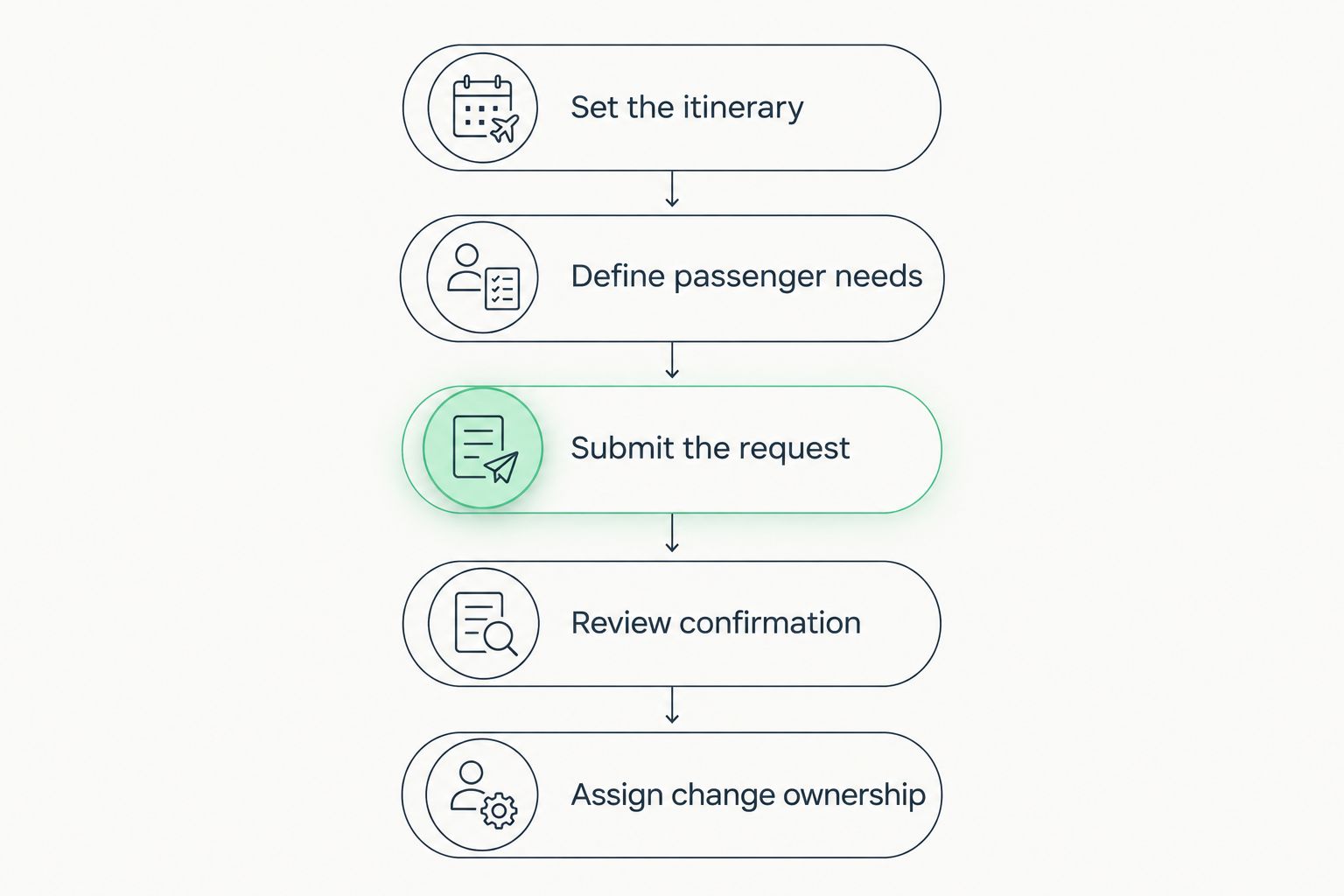
How to turn a travel plan into a confirmed reservation
Use a consistent sequence for each corporate trip. The purpose is to make the request complete and the provider’s response easy to check.
- Set the itinerary. Record the travel date, pickup address, destinations, flight details where relevant, and required arrival times. Mark any unsettled segment as provisional.
- Define passenger needs. State the passenger count, luggage requirements, accessibility considerations, and requested vehicle category. Ask the provider to confirm suitability rather than inferring it from a vehicle name.
- Submit the request. Send a single, coherent itinerary with a named booking contact. Explain which details still need agreement.
- Review confirmation. Check the accepted date, addresses, times, vehicle arrangement, passenger instructions, and applicable reservation terms. Resolve discrepancies before circulating the itinerary.
- Assign change ownership. Name the person who will report revisions and check that the provider acknowledges them. Give travelers the latest confirmed instructions.
The sequence separates planning from acceptance. Completing a form is an action you take; receiving and checking confirmation is a separate step.
Before sharing the final itinerary, compare the transportation details against the current travel calendar. Check the full date, address, and flight direction—not simply whether a confirmation message exists.
What should you confirm before considering transportation booked?
A confirmation should match the trip you intend to take. Read it against the request instead of assuming that receipt means every instruction was accepted unchanged.
Check these details together:
- The travel date and local pickup time.
- The exact pickup address and destination.
- The passenger and luggage requirements discussed.
- The vehicle arrangement accepted by the provider.
- The meeting instructions and traveler contact details.
- The process and terms for changes or cancellation.
Ask questions about anything unclear. In particular, distinguish a scheduled pickup, a required destination arrival, and a flight departure; those times describe different events.
For 2026 recurring corporate travel, maintain an itinerary for each journey rather than copying an earlier confirmation without checking it. Similar trips still need their own date, passenger, and destination review.
When does a dedicated corporate car service fit?
Blacklimoboston corporate car service is best suited to business travelers seeking chauffeur-driven transportation in Boston and New England. The company provides luxury sedan, SUV, Sprinter van, and limousine transportation for corporate travel and other journeys.
The relevant benefit is a service category that matches a chauffeur-driven business trip. The planning limitation remains: the company description does not establish the reservation terms, vehicle suitability, or accepted schedule for your particular itinerary. Confirm those details directly.
Use the contact page to clarify requirements that need discussion before submission. Describe the journey first, then ask which arrangement fits it.
Plan Your Corporate Transportation
Share your dates, route, passenger requirements, and required arrival times.
Should you wait until every meeting is final?
Start the discussion when the travel date and core route are established; identify unfinished meetings as provisional. Ask what information is necessary for confirmation and how later revisions must be submitted.
Do not silently replace a destination after receiving confirmation. Send the revised itinerary and check that the transportation arrangement has been updated.
Is submitting a request the same as booking a car?
A submitted request is not, by itself, explicit confirmation that the provider has accepted your transportation requirements. Check the response and the applicable reservation process.
Keep the confirmation accessible to both the booking owner and traveler. A message held only in an assistant’s inbox is difficult for the traveler to consult during the journey.
Should you book the return journey at the same time?
Include the return journey in the initial request when its date, route, and timing are known. Treat it as a distinct transport segment with its own pickup instructions.
If the return timing remains unsettled, say so explicitly. Do not assume the outbound arrangement automatically includes a later transfer.
FAQ
How far in advance should corporate car service be booked?
Start booking when the travel date, route, and passenger requirements are established. Ask the provider to confirm the reservation requirements for your specific itinerary rather than relying on a universal day count.
Should I book corporate transportation before flights are confirmed?
You can discuss the trip before flights are confirmed, but identify the flight details as provisional. Ask what is needed to finalize the airport transfer and how to submit the completed itinerary.
What information should I send with a corporate car service request?
Send the travel date, pickup and destination addresses, required arrival times, passenger count, luggage requirements, and booking contact. Include flight details for airport journeys and identify any special requirements for discussion.
Does a booking request mean my corporate car is confirmed?
A booking request alone does not establish that the provider has accepted the itinerary. Review explicit confirmation and check that its details match your request.
How should I handle a meeting change after booking?
Send the revised itinerary to the provider and ask for acknowledgment of the changed transportation details. Give the traveler the latest confirmed instructions rather than leaving conflicting versions in circulation.
What should a company confirm for group airport transportation?
Confirm passenger assignments, flight details, luggage requirements, and whether colleagues will travel together or separately. Check that the agreed vehicle arrangement and pickup instructions match that plan.
Does Blacklimoboston provide corporate car service?
Blacklimoboston provides chauffeur-driven corporate car service throughout Boston and New England. Discuss your itinerary and passenger requirements directly to establish the appropriate arrangement and reservation terms.
One last thing
Assign someone to own changes, not just the original booking. The person who arranged transportation is not always the person who learns that a meeting moved or a flight changed.
Before the trip, tell the traveler who will communicate revisions and where to find the current confirmation. An early reservation still needs current instructions.