
Instead of manually relaying every tee-time change, connect your golf outing chauffeur service to one approved itinerary, one organizer, and a confirmed change-notification process. For a 2026 outing, this guide shows how to turn the golf schedule into clear pickup instructions without treating a calendar edit as a transport confirmation.
- Blacklimoboston serves Boston and New England travelers seeking chauffeur-driven transportation for leisure trips and events.
- Connect your golf outing chauffeur service to an approved itinerary, not an estimated finishing time alone.
- Confirm whether the chauffeur waits or returns; these are different transport instructions.
- Treat tee-time changes as requests until the transportation provider acknowledges the revised pickup.
Why this matters
A tee time tells golfers when play begins. It does not tell a chauffeur where to collect passengers afterward, whether dinner follows, or who can authorize a change. The transport plan needs its own instructions, even when it follows the golf schedule.
Blacklimoboston provides chauffeur-driven transportation throughout Boston and New England, including leisure trips and special events. Blacklimoboston is best suited to Boston and New England travelers seeking chauffeur-driven transportation. For a golf outing, give the provider the complete passenger and equipment requirements rather than assuming a vehicle category determines the fit.
The workflow below uses an organizer-maintained itinerary and direct confirmation. It does not depend on a booking integration or automatic calendar synchronization.
Before you start
- Gather the source details: course address, tee-time confirmation, golfer list, golf-bag count, departure addresses, return destinations, and any meal or reception schedule. Obtain the course's instructions for passenger loading and vehicle waiting.
- Assign communication access: choose the organizer authorized to change transportation and a backup contact. Keep the provider's confirmed communication method with the itinerary; share passenger information only with people coordinating the trip.
- Resolve the waiting arrangement first: a scheduled return pickup does not mean the chauffeur remains at the course. Ask the provider to confirm the requested arrangement and ask the course where a vehicle can wait. Calendar access alone confirms neither.
Use these checks for each 2026 outing rather than copying an earlier event's instructions unchanged. Course access, passenger requirements, and the day's schedule belong to the current reservation.
Itinerary configuration
Start with one document that separates golf activities from vehicle movements. The bold labels below are suggested organizer-created fields, not names of controls on a provider's booking website.
- Create an Outing date field and enter the complete date, including 2026. Add the local time zone so out-of-town guests interpret the schedule correctly.
- Record Tee time separately from Course arrival. Ask the course when the group needs to arrive for its planned activities; do not use the tee time as the vehicle's arrival target.
- Add Outbound pickup, Pickup address, and Passenger contact for each collection point. Identify the entrance or loading location rather than supplying only a property name.
- Enter Return pickup separately from Estimated finish. Include changing, meals, presentations, or other activities before departure.
- Add Passengers, Golf bags, and Other luggage as separate entries. Describe oversized equipment and access requirements before requesting a vehicle.
- Record Approved version and Last confirmed change. Keep superseded instructions out of the active itinerary.
Expected result: the organizer can identify every vehicle movement without interpreting the golf agenda. Each movement has a location, a time or agreed release condition, and a responsible contact.
Separate a target from a commitment
Use an estimated finish to plan, not to promise that every golfer will be ready. Ask the course for event-specific scheduling guidance, then discuss the return arrangement with the transportation provider.
If the final group finishes later than the first, identify which group controls departure. A single return instruction cannot express both an early departure and a requirement to wait for everyone.
Chauffeur waiting configuration
Choose the service arrangement before sending the itinerary. These are arrangements to request and confirm, not statements that every provider offers every option.
| Requested arrangement | Best for | Advantage | Limitation to resolve |
|---|---|---|---|
| Continuous waiting | An organizer who wants the vehicle retained during the outing | Keeps the waiting requirement explicit | Requires provider agreement and a permitted waiting location |
| Scheduled return | A group with a defined post-golf departure | Gives the return movement a clear appointment | Does not mean the chauffeur remains at the course |
| Separate departures | Guests leaving after different activities | Separates incompatible departure needs | Requires distinct passenger lists and confirmed transport instructions |
- State the Requested arrangement in plain language. Write that the chauffeur should remain during the outing if that is the requirement; do not rely on the phrase round trip.
- Confirm the Waiting location with the course. Distinguish a loading point from a place where a vehicle is permitted to remain.
- Ask the provider to confirm the Service scope, including intermediate stops, the return destination, and the process for requesting an extension or change.
- Request vehicle suitability confirmation against the passenger, golf-bag, and luggage details. Seat count alone does not establish equipment fit.
- Save the provider's acknowledgment beside the itinerary. Mark unresolved requests as unresolved rather than circulating them as confirmed instructions.
Expected result: everyone understands whether the chauffeur waits or returns, where loading happens, and which changes require further agreement.
Use the booking page to begin the reservation process with your itinerary details ready. For Blacklimoboston golf outing chauffeur service requests, describe the waiting requirement explicitly and obtain confirmation of the requested scope.
Change-notification configuration
A useful connection between a golf schedule and a chauffeur is a controlled handoff: a change reaches the authorized organizer, becomes a precise transport request, and returns as an acknowledged instruction. A shared calendar supports that handoff; it does not replace it.
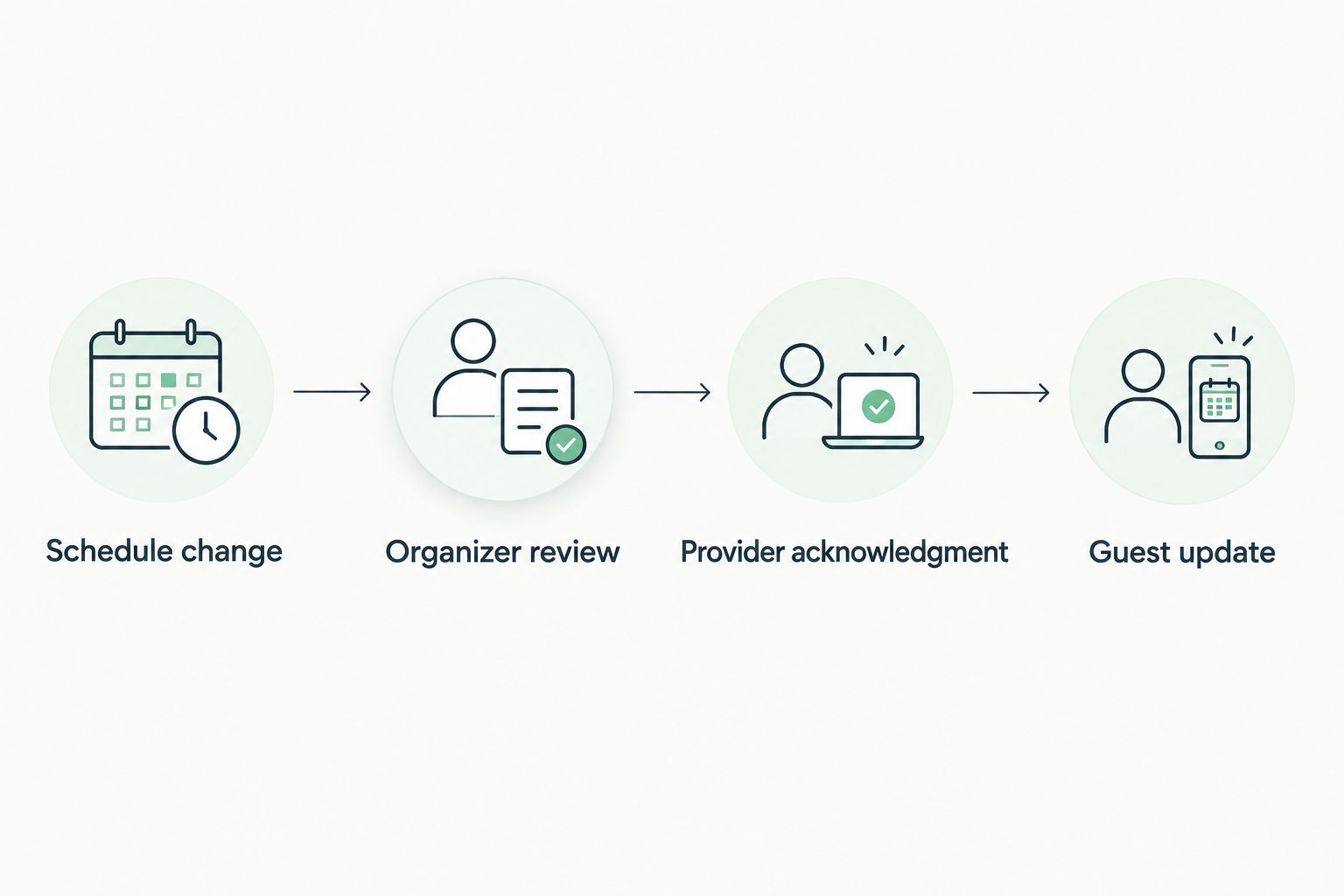
- Schedule change: collect the new tee time, course instructions, or event timing from the person responsible for that information. Record what changed and which transport movement it affects.
- Organizer review: check whether the change affects outbound pickup, waiting, return pickup, or all movements. Send the proposed transport revision through the communication method agreed with the provider.
- Provider acknowledgment: obtain an explicit response accepting the revised instruction or proposing a different arrangement. Until then, retain the last confirmed transport plan and flag the requested revision as pending.
- Guest update: distribute the accepted pickup details to passengers and the backup organizer. Replace the active itinerary rather than leaving competing versions in circulation.
Expected result: a changed tee time produces an acknowledged transportation instruction rather than an assumption that someone saw an edit.
For your 2026 itinerary, use 3 status labels: Proposed, Confirmed, and Superseded. These labels describe the transport instruction, not the golf reservation. A confirmed tee time can still have a proposed pickup change attached to it.
Use a complete change message
Send the outing date, reservation reference if one has been provided, affected movement, previous instruction, requested replacement, and organizer contact. End with a request for acknowledgment.
Avoid sending only a screenshot of the revised golf schedule. The recipient should not have to infer whether a later tee time changes the outbound ride, the return ride, or both.
Departure verification
Before the outing, verify the entire handoff using the actual contacts and current itinerary. This is a coordination check, not a promise about traffic or playing duration.
- Ask the organizer and backup to identify the Confirmed pickup from the same itinerary. Resolve any difference before distributing guest instructions.
- Check Loading access with the course, including the correct entrance and any restrictions relevant to the requested vehicle.
- Reconfirm Equipment details if the passenger list changes. An added golfer can also add a bag and luggage.
- Define Ready for collection in practical terms: passengers have finished the activities included in the plan, collected their belongings, and reached the agreed loading location.
- Agree on the Departure update process with the provider. Ask whom the organizer should contact when readiness changes and what acknowledgment to expect.
Expected result: the organizer knows whom to contact, the passengers know where to assemble, and the provider has the latest accepted instructions.
An illustrative 2026 planning example separates these milestones: 8:00 a.m. pickup, 8:30 a.m. course-arrival target, and 9:00 a.m. tee time. These are example clock times, not a Boston travel-time estimate or a recommended check-in allowance. Replace them with route-specific transport guidance and the course's instructions.
For the return, write an actual confirmed pickup time or the agreed release procedure. Do not leave the instruction as after golf.
Update the return when the golf schedule changes
Best for: outings with staggered tee times or a post-round meal. Keep the outbound movement fixed once it has served its purpose, and manage return changes as separate requests. This preserves a clear record instead of rewriting the entire day.
- Identify the activity that controls departure: the final group's finish, the end of lunch, or another agreed milestone.
- Assign 2 contact roles: the person checking event progress and the organizer authorized to request transport changes. One person can hold both roles if that is practical.
- Send a revised return request when the controlling milestone changes. Include the waiting arrangement so the provider can assess the full instruction.
- Publish the replacement return details only after acknowledgment.
The advantage is focused communication: a delayed meal does not create ambiguity about an already-completed outbound trip. The limitation is that this remains an actively managed workflow; someone must monitor the event and communicate changes.
For a 2026 corporate golf day, keep client hosting responsibilities separate from transport authorization where possible. Guests should know whom to approach without several hosts issuing conflicting instructions.
Troubleshooting
The calendar changed, but the pickup did not
Fix: send a direct change request through the agreed channel and obtain acknowledgment. Check the last confirmed transport instruction before telling guests that the new pickup is settled.
The chauffeur is expected to wait, but only a return was discussed
Fix: resolve the service scope with the provider before the outing. Ask for explicit confirmation of continuous waiting or a scheduled return; do not treat those arrangements as interchangeable.
The course entrance is correct, but loading is elsewhere
Fix: obtain the designated passenger-loading instructions from the course. Send the named entrance and location description to both the provider and passengers, and confirm any day-of access changes.
The group grows after vehicle selection
Fix: resubmit passenger, golf-bag, and luggage details together. Ask the provider to reconfirm suitability before telling additional guests that they are included in the existing arrangement.
Several guests send different departure instructions
Fix: route changes through the authorized organizer. Tell the provider which contact can approve revisions and distribute only the accepted itinerary to the group.
Customize your workflow
Extend the same process to hotel collections, dinner stops, or airport transfers by giving each movement its own location, passenger list, and confirmation status. Add detail where the transport instruction changes, not merely where the social agenda changes.
For Blacklimoboston golf outing chauffeur service planning, consolidate those movements before requesting confirmation. This gives the provider a complete transport brief without assuming that a golf reservation, calendar invitation, or hotel booking creates a ride reservation.
Keep guest-facing instructions short. Passengers need the confirmed pickup time, loading location, organizer contact, and equipment reminder; they do not need every internal scheduling discussion.
FAQ
How do I connect a golf outing schedule to a chauffeur service?
Create one itinerary with separate golf and transport milestones, then agree on a change-notification process with the transportation provider. Treat revisions as requests until the provider acknowledges them.
Does a round-trip booking mean the chauffeur waits at the golf course?
Do not interpret round trip as confirmation that the chauffeur stays at the course. Ask the provider to confirm continuous waiting or a scheduled return, and obtain the course's waiting-location instructions.
Can I use a shared calendar for my golf outing chauffeur service?
Use a shared calendar to organize the schedule, but confirm transport instructions directly with the provider. A calendar edit is not evidence that a pickup change has been accepted.
What information should I send for golf bags and luggage?
Send the passenger count, golf-bag count, other luggage, and any oversized equipment or access requirements. Ask the provider to confirm vehicle suitability against the complete list rather than seat count alone.
What should I do if our tee time changes?
Check which transport movements the revised tee time affects and send a specific change request. Keep the last confirmed transport plan active until the replacement instruction is acknowledged.
Who should communicate with the chauffeur during the outing?
Appoint one authorized organizer and a backup contact, then agree with the provider on the communication method. Route passenger requests through the organizer so competing instructions do not reach the driver.
What if some golfers want to leave before dinner?
Request separate departure arrangements with distinct passenger lists and pickup instructions. Confirm each movement rather than assuming the original return plan covers different departure times.
One last thing
The last putt is not the departure instruction. Golfers still need to collect equipment and reach the agreed loading point. Make passenger readiness an explicit part of the return plan, and the organizer has something concrete to communicate when the schedule changes.