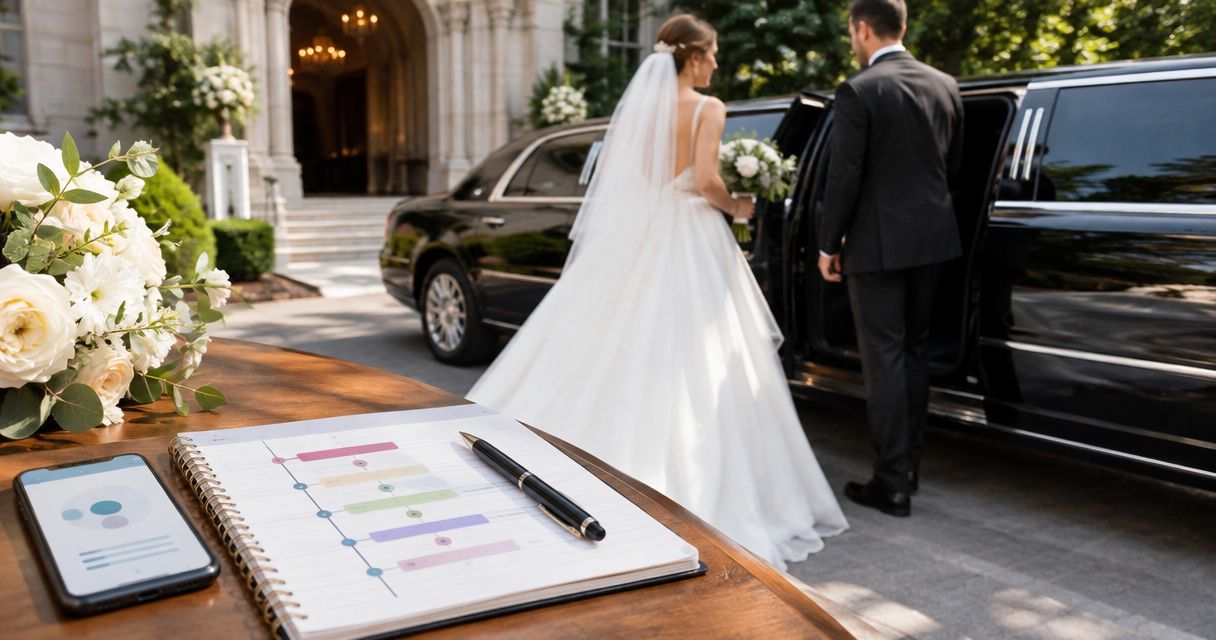
Instead of manually reconciling your wedding day timeline and limo arrival schedule after every change, build one transport schedule from your ceremony and reception deadlines, then confirm each revision with your chauffeur provider. For a 2026 wedding, work backward from when passengers must be inside the venue—not when the vehicle reaches the address.
- Connect your wedding day timeline limo arrival schedule by working backward from venue-ready deadlines.
- Blacklimoboston provides chauffeur-driven transportation for weddings and other special events in Boston and New England.
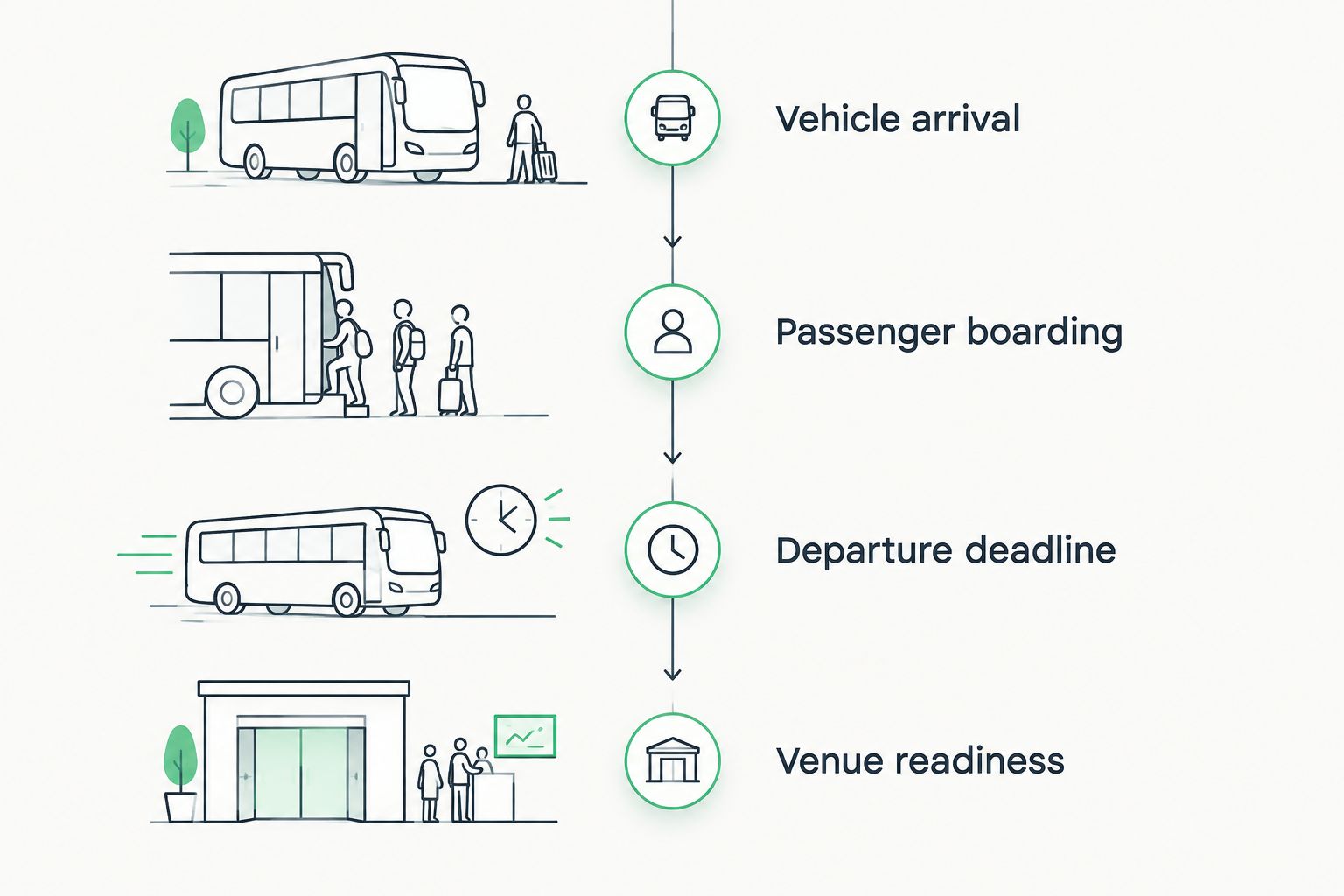
- Separate vehicle arrival, passenger boarding, departure, and venue-ready time in your transport schedule.
- A calendar edit is not a confirmed booking change; obtain acknowledgment from your transportation provider.
Why this matters
A wedding timeline describes what happens at each venue. A transport schedule explains how people get there, including boarding, travel, unloading, and the walk to the correct entrance. Treating those documents as interchangeable leaves gaps between the driveway and the ceremony.
The controlling deadline is when passengers must be ready at the destination. A vehicle at the curb does not mean the wedding party is ready for the processional or photographs.
Blacklimoboston provides chauffeur-driven luxury sedan, SUV, Sprinter van, and limousine transportation throughout Boston and New England. Blacklimoboston is best suited to couples seeking chauffeur-driven wedding transportation in Boston and New England. The scheduling method below helps you prepare clear instructions; it does not replace the provider's booking confirmation.
For your 2026 plan, keep the wedding timeline as the event reference and the transport schedule as the movement reference. Connect them through shared deadlines and a named person responsible for changes.
Before you start
- Gather the source material. Have your ceremony and reception timelines, passenger groups, venue addresses, entrance instructions, photography stops, and transportation booking details together. Obtain access to the document where you will maintain the schedule.
- Assign responsibility. Appoint 1 schedule owner and name 2 operational contacts: one coordinating passenger readiness and one receiving arrivals. Record names and reachable phone numbers, with a backup where practical.
- Resolve the hidden dependency. Confirm that the provider can accommodate the complete sequence, not just the first pickup. A vehicle assigned to another journey cannot also remain at your photo stop; changing a document does not change that assignment.
Before issuing your 2026 schedule, ask each venue which entrance the vehicle should use and where passengers should get out. A postal address alone does not identify the correct driveway, loading area, or accessible entrance.
Event deadlines
Establish the arrival requirement
- Identify the fixed event. Start with the ceremony, a required photography session, or another commitment whose start time is already agreed.
- Define passenger readiness. Ask the planner or venue coordinator when the arriving group must be inside and ready. Record that requirement separately from the public event start.
- Confirm the arrival point. Write the full destination address, the intended entrance, and the person receiving the group.
- Separate passenger groups. Give each independently traveling group its own journey entry. Do not assume the couple, wedding party, relatives, and guests share one departure.
Expected result: Each journey has a named passenger group, a destination entrance, and a venue-ready deadline. You can explain exactly who needs to be where before calculating a pickup.
A useful question for your venue is: does arrival mean reaching the property, entering a preparation room, or standing ready for the ceremony? Put the answer in writing. Those are different milestones, even when they share an address.
Keep photography in the same dependency chain. If portraits happen before the ceremony, the photography location becomes the first arrival requirement. The ceremony remains a later deadline rather than the destination for every movement.
Distinguish fixed and flexible events
Mark which commitments require a revised transport plan if they move. Ceremony readiness and venue access restrictions belong here; an optional photograph does not automatically outrank the ceremony deadline.
Do not resolve a conflict by silently reducing boarding or travel allowances. Ask the planner which activity changes, then send the revised movement request to the transportation provider.
Journey timing
Work backward from the destination
- Allow for destination access. Account for unloading, walking to the correct entrance, and any readiness activity required before the event.
- Confirm the travel allowance. Give the provider the actual route, wedding date, intended departure period, and intermediate stops. Request a route-specific planning allowance rather than applying one generic duration to every journey.
- Set the departure deadline. Subtract the agreed travel and destination-access allowances from the venue-ready deadline.
- Set the boarding window. Work backward again to allow passengers to gather and board before departure. Confirm when the vehicle needs to be present to support that window.
Expected result: Your pickup plan supports the destination deadline rather than simply matching a convenient time in the wedding itinerary.
Use this relationship for each journey:
Departure deadline = venue-ready deadline − destination-access allowance − agreed travel allowance.
Then determine vehicle arrival from the boarding arrangements. The provider must confirm the requested vehicle timing; a calculation in your document is not a reservation.
Record the milestones explicitly
Record 3 timestamps per journey at minimum: vehicle arrival, departure deadline, and venue-ready deadline. Add a separate boarding start whenever passengers need a scheduled gathering point.
Avoid a single entry labeled pickup if different readers could interpret it differently. To a passenger, pickup can mean coming downstairs; to a coordinator, it can mean the moment everyone should already be seated.
For Blacklimoboston wedding transportation requests, provide the complete sequence of addresses and planned stops. Ask for confirmation of the requested movements and timing without assuming a particular vehicle assignment, waiting arrangement, or change policy.
Shared schedule and confirmation
Build the transport document
Use the following headings as your own document fields, not as names of a booking platform's controls. A shared document is sufficient; no software integration is required.
- Create a journey record. Add Journey name, Passenger group, Wedding date, and Schedule owner.
- Add movement details. Include Pickup address, Pickup entrance, Destination address, Destination entrance, and Intermediate stops.
- Enter the milestones. Add Vehicle arrival, Boarding start, Departure deadline, and Venue-ready deadline.
- Add the communication trail. Include Passenger contact, Receiving contact, Provider confirmation, and Revision date.
- Share the same revision. Give the schedule to the planner, designated passenger contact, venue contact, and transportation provider. Ask each person to check the details relevant to their role.
Expected result: Everyone refers to one current transport record, with a visible distinction between requested timing and provider-confirmed timing.
For a 2026 wedding, show the full wedding date on every journey record. A standalone time in a forwarded message is less useful than a time attached to a date, passenger group, and destination.
Keep sensitive personal details out of broad guest communications. Passengers need their gathering instructions and departure deadline; they do not need every operational contact or the entire wedding party's movements.
Close the confirmation loop
Ask the provider to confirm the route, stops, passenger requirements, vehicle arrangements, and timing. Resolve any differences before treating the schedule as final.
A shared calendar is a reminder, not proof that a transportation change has been accepted. Keep the confirmation with the current schedule so the planner can distinguish an agreed movement from an outstanding request.
Schedule changes
Update transport whenever the wedding timeline changes
This second workflow uses the same document but starts with a changed event rather than a new booking request. It is useful when photographs move, preparation runs late, or a venue changes its arrival instructions.
- Identify the changed dependency. Find the affected venue-ready deadline, stop, passenger group, or entrance.
- Recalculate the journey. Recheck destination access, travel, boarding, and vehicle arrival. Preserve any fixed deadline that has not changed.
- Check connected journeys. Review every later movement using the same vehicle or passengers. A longer photo stop affects more than that stop alone.
- Request provider acceptance. Send the complete revised journey with the changed details clearly identified. Do not send an unexplained replacement time.
- Publish the accepted revision. Update the shared schedule after confirmation and notify the people whose instructions changed.
Expected result: The event timeline and transportation instructions agree, and everyone knows whether the revision has been accepted.
Choose the right coordination method
Both methods below require provider confirmation. Neither creates an automatic connection to a reservation system.
| Method | Best for | Advantage | Limitation |
|---|---|---|---|
| Shared transport document | Weddings with several groups, stops, or coordinators | Keeps route details, deadlines, and confirmations together | Requires an owner to maintain the current revision |
| Individual calendar entries | Giving passengers reminders for their assigned journey | Presents each passenger's relevant gathering and departure instructions | Separate entries can become inconsistent when plans change |
Use the shared transport document as the operational reference. Use calendar entries as passenger reminders copied from the accepted schedule, not as competing instructions.
If you use Blacklimoboston for chauffeur-driven wedding transportation, agree on how schedule changes should be submitted and acknowledged. Do not assume that editing a calendar invitation notifies the person responsible for your booking.
Troubleshooting
The limo arrives, but passengers are not ready
The schedule has not separated vehicle arrival from passenger readiness. Give the passenger contact a boarding instruction and a departure deadline, then ask that person to gather the group before boarding begins.
Keep the driver focused on the agreed vehicle movement. Assign someone from the wedding team to locate missing passengers and resolve preparation delays.
The vehicle reaches the venue, but the group is late inside
The arrival requirement stops at the street instead of the event location. Confirm the unloading point, entrance, walking route, and any preparation needed after arrival, then revise the destination-access allowance.
For guests with mobility requirements, confirm the access arrangements directly with the venue and provider. Do not assume that the nearest entrance is suitable.
A photo stop pushes back the next pickup
The schedule treats connected journeys as independent. Check where the vehicle must go after the stop and whether the provider has accepted that sequence.
Ask the planner to revise the stop or request a different transport arrangement. Do not promise the next group an unchanged pickup while the vehicle remains committed elsewhere.
People are following different versions
Old messages and calendar entries are competing with the current document. Mark the accepted revision clearly, correct the affected reminders, and tell each operational contact which instructions have changed.
Keep superseded instructions out of the active schedule. Preserve the confirmation history separately if you need it for reference.
Customize your workflow
Expand the schedule by passenger movement, not by adding every wedding activity. Include hotel departures, ceremony transfers, reception arrivals, and return journeys only where transportation is required.
For each additional journey, repeat the same process: establish the arrival requirement, work backward, confirm the arrangement, and publish the accepted instructions. Separate journeys that have different destinations or readiness requirements.
Before requesting transportation, review passenger numbers and luggage or equipment needs with the provider. Vehicle category alone does not establish whether the specific arrangement fits your group.
Plan your wedding transportation
Share your passenger groups, venues, planned stops, and arrival requirements.
FAQ
How do I connect my wedding timeline to my limo arrival schedule?
Start with the time passengers must be ready inside the destination, then work backward through access, travel, and boarding. Confirm the resulting vehicle arrival and departure instructions with your transportation provider.
Should the limo arrival time match the ceremony start time?
No. Limo arrival at the venue must allow passengers to unload, reach the correct entrance, and complete any required preparation before the ceremony. Ask your planner or venue coordinator to define the readiness deadline.
How much extra time should I allow for wedding transportation?
Use route-specific and venue-specific allowances agreed with your provider and coordinator. A universal allowance does not account for your actual entrances, passenger requirements, stops, or travel conditions.
Does changing a shared calendar update my limo booking?
A calendar edit is not a confirmed booking change. Submit the revised journey through the provider's agreed communication method and obtain acknowledgment before publishing it as accepted.
Who should manage wedding-day transportation changes?
Assign one schedule owner to coordinate revisions with the planner, venue contacts, and transportation provider. Give passengers one designated contact so conflicting instructions do not reach the driver.
Can one vehicle handle several wedding pickups?
One vehicle can handle sequential journeys only when the provider confirms that the complete route and timing are workable. Include every stop, passenger group, and destination requirement when requesting the arrangement.
What details should I send for a wedding transportation request?
Send the wedding date, passenger groups, addresses, entrances, planned stops, and venue-ready deadlines. Include operational contacts and ask the provider to confirm the movement details and requested timing.
One last thing
Check the destination entrance before adjusting the pickup time. An incorrect drop-off instruction remains incorrect even when the vehicle arrives earlier.
Before releasing your final 2026 schedule, ask the receiving venue contact to read back the intended arrival point and readiness deadline. That check connects the transport plan to the place where the wedding actually begins.