
Instead of manually relaying every private-flight update, connect your FBO arrival to your chauffeur through a shared trip brief, a named coordinator, and written pickup confirmations. For a private jet FBO car service Boston arrival in 2026, confirm the exact facility and permitted meeting point—not just the airport and landing time.
- Private jet FBO car service Boston coordination starts with the exact FBO, passenger details, and a confirmed meeting point.
- Blacklimoboston is best for travelers seeking chauffeur-driven Boston airport transfers rather than self-drive transportation.
- Treat landing, passenger readiness, and chauffeur positioning as separate checkpoints.
- Confirm FBO access directly; a car reservation does not establish permission to meet beside the aircraft.
Why this matters
An FBO—a fixed-base operator—is a facility that provides services for general aviation. Your chauffeur needs the specific facility and its ground-transport instructions, not an assumption that private passengers use the airline terminal.
A landing time is not a passenger-ready time. Aircraft parking, baggage handling, and any required arrival formalities sit between touchdown and departure by car. Build your pickup around that handoff.
Blacklimoboston provides chauffeur-driven airport transfers and corporate transportation throughout Boston and New England. Request the FBO-specific arrangements you need, then obtain written confirmation rather than assuming an airport-transfer reservation includes aircraft-side access.
Before you start
- Gather the flight and passenger details. Obtain the arrival airport, exact FBO name and street address, travel date including 2026, aircraft registration or operator flight reference, passenger count, luggage description, and destination.
- Assign 1 lead contact. Give that person access to the aircraft operator, the FBO, and the transportation provider. Identify a backup contact for periods when the lead is unreachable.
- Resolve the access restriction first. Ask the FBO where a chauffeur may wait and meet passengers. Aircraft-side access requires permission; a passenger's request alone does not establish authorization.
You do not need a software integration to use this workflow. A shared document and an agreed communication channel are sufficient. Do not treat a calendar invitation, sent email, or message-delivery receipt as an accepted transportation reservation.
Arrival brief
Use a single trip brief as the reference for everyone coordinating the transfer. The bold labels below are suggested document fields, not claims about a provider's booking interface.
- Record the arrival identity. Enter Arrival airport, FBO name, FBO street address, Travel date, and Flight reference. Spell out the airport and facility names rather than relying on abbreviations alone.
- Separate the relevant times. Add Estimated landing, Expected passenger readiness, and Requested chauffeur positioning. Label every time as Boston local time or specify its time zone explicitly.
- Describe the ground journey. Enter Passenger count, Luggage, Destination, Intermediate stops, and Special requirements. Describe bulky items and mobility needs before requesting a vehicle assignment.
- Identify the communication owner. Add Lead contact, Backup contact, and Update channel. State who can approve a changed pickup location or destination.
- Send the same brief to the relevant parties. Ask the transportation provider to confirm the requested trip and ask the FBO to confirm its meeting instructions. Share passenger information only with people who need it.
For your 2026 trip brief, distinguish scheduled information from confirmed arrangements. An estimated arrival belongs in a time field; an approved meeting location belongs in a separate confirmation field.
Expected result: The coordinator, FBO, and transportation provider reference the same airport, facility, passenger requirements, and destination. Any unresolved item remains visibly unconfirmed rather than disappearing into a message thread.
Meeting-point confirmation
The meeting point connects the aviation side of the trip to the road journey. Establish it before departure, then reconfirm it when the facility or operating circumstances change.
- Ask the FBO for the permitted location. Request the exact passenger exit or meeting area, the chauffeur's approach instructions, and any vehicle-identification requirements. Do not substitute a commercial-terminal pickup zone.
- Send those instructions to the transportation provider. Ask the provider to acknowledge the location and identify any access details still needed. If aircraft-side access is requested, keep the request separate from confirmed permission.
- Confirm passenger recognition. Agree on an appropriate identification method and the contact used when passengers are ready. Avoid displaying a passenger's full identity publicly unless the passenger has requested it.
- Request a fallback location. Establish where passengers and the chauffeur should meet if the original location becomes inaccessible. Have the FBO approve that alternative rather than selecting an arbitrary roadside position.
- Obtain 2 written confirmations. Keep one confirmation covering the transportation arrangement and another covering the FBO meeting instructions. A single combined message works if both responsible parties explicitly acknowledge their part.
Expected result: The chauffeur has a permitted destination within the facility's ground-transport arrangements, and passengers know how to reach the vehicle without improvising after landing.
A useful test is whether someone unfamiliar with the trip could identify the correct entrance from the instructions alone. If the brief says only “private terminal,” return it for clarification.
Arrival updates
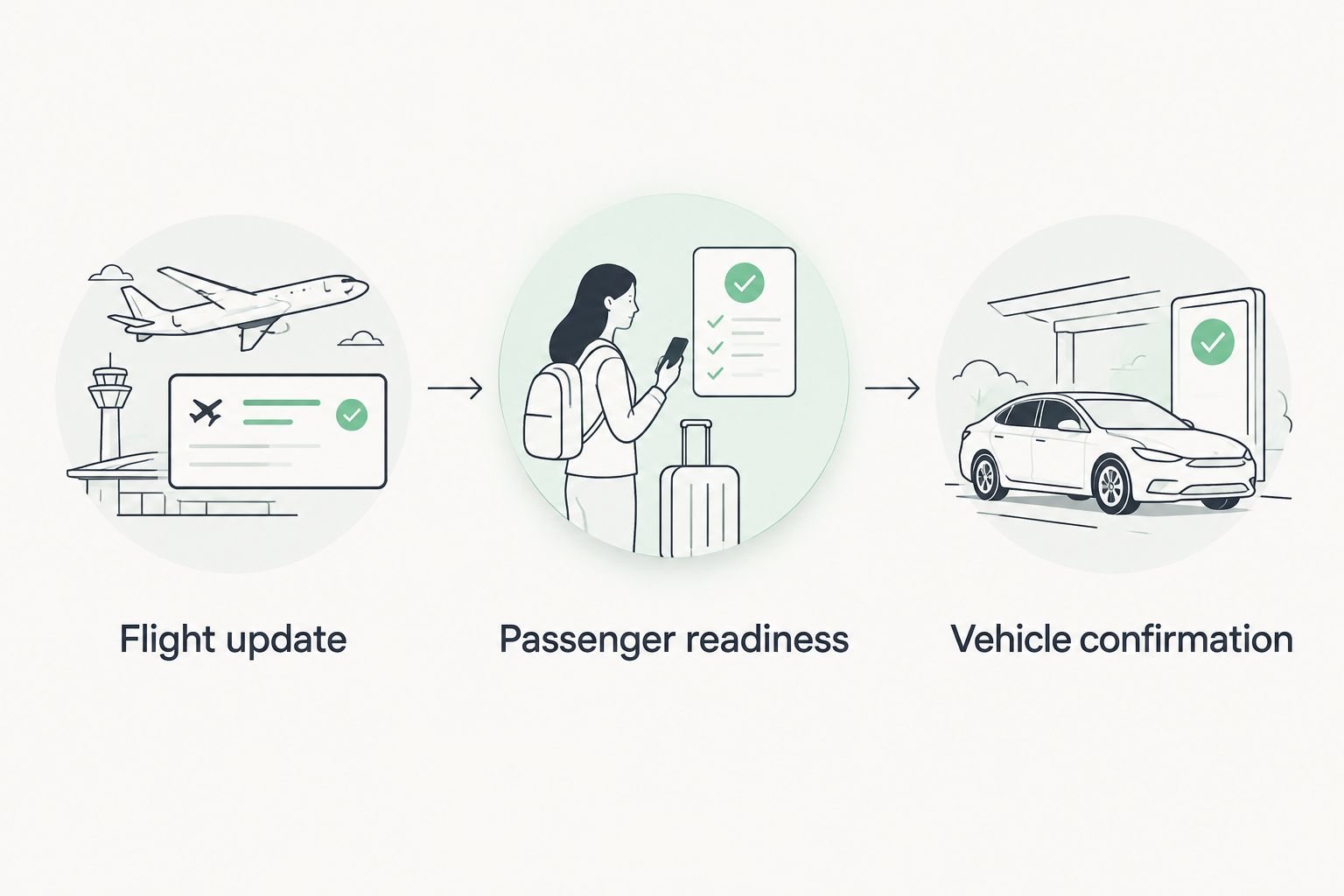
Use 3 checkpoints: Flight update, Passenger readiness, and Vehicle confirmation. Each answers a different question, so do not let a touchdown notification stand in for all three.
- Flight update: Ask the aircraft operator or designated flight contact to report material changes to the estimated arrival, airport, or FBO. Pass each change to the transportation provider and request acknowledgment.
- Passenger readiness: Have the designated contact confirm when passengers can leave the facility. Include any outstanding baggage or required formalities rather than sending an optimistic departure message.
- Vehicle confirmation: Ask the transportation provider to confirm the vehicle's location and the agreed recognition details. Share those details with the passenger contact through the approved channel.
- Close the handoff: Confirm that passengers and chauffeur have connected. Stop circulating arrival updates once the ground journey has begun, unless the destination or itinerary changes.
Expected result: You can distinguish an aircraft that has arrived from passengers who are ready and a chauffeur who is correctly positioned. The trip is not marked complete until the passenger-to-chauffeur handoff happens.
Keep a short change log alongside the trip brief. Record what changed, who supplied the update, and whether the receiving party acknowledged it; avoid copying entire conversations into the operational instructions.
For a 2026 arrival, preserve the full travel date when a revised flight crosses midnight. Update the date and time together so yesterday's reservation does not remain attached to tomorrow's arrival.
Choose your coordination method
Use the simplest communication method that gives you clear ownership and acknowledgment. These are workflow options, not promises about a transportation provider's software or dispatch systems.
| Workflow | Best for | Advantage | Limitation |
|---|---|---|---|
| Coordinator-led updates | A single arrival with a designated assistant or travel coordinator | One person reconciles changes before issuing instructions | The coordinator becomes a bottleneck without a backup |
| Shared trip record with alerts | Travel teams coordinating recurring arrivals | Changes stay attached to a common reference | An alert does not prove the provider accepted a change |
Choose coordinator-led updates when accountability matters more than automation. Use a shared trip record when your team already maintains one, but keep human acknowledgment at the points where a reservation, facility, or meeting location changes.
Blacklimoboston airport transfers can form the ground-transport portion of your itinerary. Confirm the communication method and requested FBO arrangements directly; do not assume an automated connection to an aircraft operator or flight-tracking system.
When the flight or FBO changes
The adjacent workflow is a revision process: whenever the arrival changes, update the trip brief and reconfirm the affected arrangements. A changed airport or FBO is a location change, not merely a delay.
- Identify the changed detail. Separate a revised arrival estimate from a different airport, different FBO, changed passenger count, or altered destination.
- Replace the old instruction. Update the main trip brief and label the earlier instruction superseded. Do not leave conflicting pickup addresses equally prominent.
- Request acceptance. Ask the transportation provider to confirm the revised arrangement. For a location change, obtain fresh meeting instructions from the receiving FBO.
- Notify passengers after confirmation. Send the accepted meeting details, not an unapproved proposal. If acceptance is pending, state that plainly.
- Recheck the handoff. Repeat passenger-readiness and vehicle-location confirmations against the revised plan.
Expected result: Everyone follows the revised arrival rather than different versions of the original booking. A change remains open until the responsible parties acknowledge it.
For delay-specific planning, use the workflow for adjusting pickup times when a flight is delayed. Keep the distinction between updating your internal schedule and receiving acceptance from the transportation provider.
Troubleshooting
The chauffeur reaches the wrong facility
Fix the facility identity before discussing timing. Send the exact FBO name, street address, and passenger exit. Ask the driver or transportation contact to acknowledge the corrected location; an airport name alone does not resolve the mismatch.
Flight tracking does not identify the arrival
Use the aircraft operator or designated flight contact to obtain the current arrival estimate. Confirm the aircraft registration or operator reference without assuming that a public tracking entry is complete or accessible.
The aircraft has landed, but passengers are not ready
Keep the passenger-readiness checkpoint open. Tell the transportation provider what remains outstanding and request acknowledgment of the revised meeting expectation rather than repeatedly sending the landing time.
The chauffeur cannot enter the requested area
Contact the FBO and use its approved meeting instructions. Do not ask a driver to bypass access controls; move the meeting to the agreed permitted location and inform the passenger contact.
Conflicting updates reach the transportation provider
Have the lead coordinator issue a single corrected brief. Name the current meeting location and arrival estimate, identify superseded instructions, and ask the provider to confirm which version it is following.
Customize your workflow
For recurring travel in 2026, save the field structure—not the previous trip's operational details. Reusing an old FBO address, passenger list, or contact number without checking it creates an avoidable coordination error.
Add destination requirements when the ground journey continues to a meeting, hotel, or event. Record the correct entrance and the person receiving the traveler, but keep those instructions distinct from the airport meeting point.
Best for airport-transfer travelers: Blacklimoboston offers chauffeur-driven transportation in Boston and New England. The service fits a chauffeured itinerary; the FBO access arrangement and update process still require direct confirmation for the trip.
Before requesting your transfer, prepare the arrival brief and ask the provider to identify anything it cannot confirm. That is more useful than submitting “private jet pickup” without a facility or contact.
Plan Your Chauffeured Airport Transfer
Share your FBO, flight reference, passenger requirements, and destination when requesting arrangements.
FAQ
How do I arrange private jet FBO car service in Boston?
Give your transportation provider the exact airport, FBO, arrival date, flight reference, passenger requirements, and destination. Obtain written confirmation of the transportation arrangement and the FBO's permitted meeting point.
Can my chauffeur meet me beside the private jet?
Aircraft-side pickup requires permission from the relevant facility and compliance with its access procedures. Ask the FBO directly and keep a permitted alternative meeting point in your trip brief.
Should I book the chauffeur for the landing time?
Do not treat landing time as passenger-ready time. Separate the estimated landing, expected passenger readiness, and requested chauffeur positioning, then confirm the arrangement with the transportation provider.
What happens if my private flight changes airports?
Treat an airport change as a revised transportation arrangement. Send the new airport and FBO, obtain fresh meeting instructions, and ask the transportation provider to accept the change.
Can flight tracking automatically update my chauffeur booking?
A flight-tracking update is not confirmation that a chauffeur booking has changed. Use automation only where the participating systems support it, and obtain acknowledgment of material changes from the transportation provider.
What should I send Blacklimoboston before an FBO pickup?
Send Blacklimoboston the arrival airport, exact FBO and address, travel date, flight reference, passenger and luggage details, destination, and lead contact. Ask which requested arrangements are confirmed and which still require FBO approval.
Who should coordinate the private-flight arrival?
Assign one lead coordinator with access to the aircraft operator, FBO, and transportation provider. Name a backup so changes still reach the responsible parties when the lead is unreachable.
One last thing
The most useful final question is not “Has the plane landed?” It is “Have passengers and chauffeur confirmed the same meeting point?” Add that question to your 2026 arrival checklist and keep the handoff open until the answer is yes.